
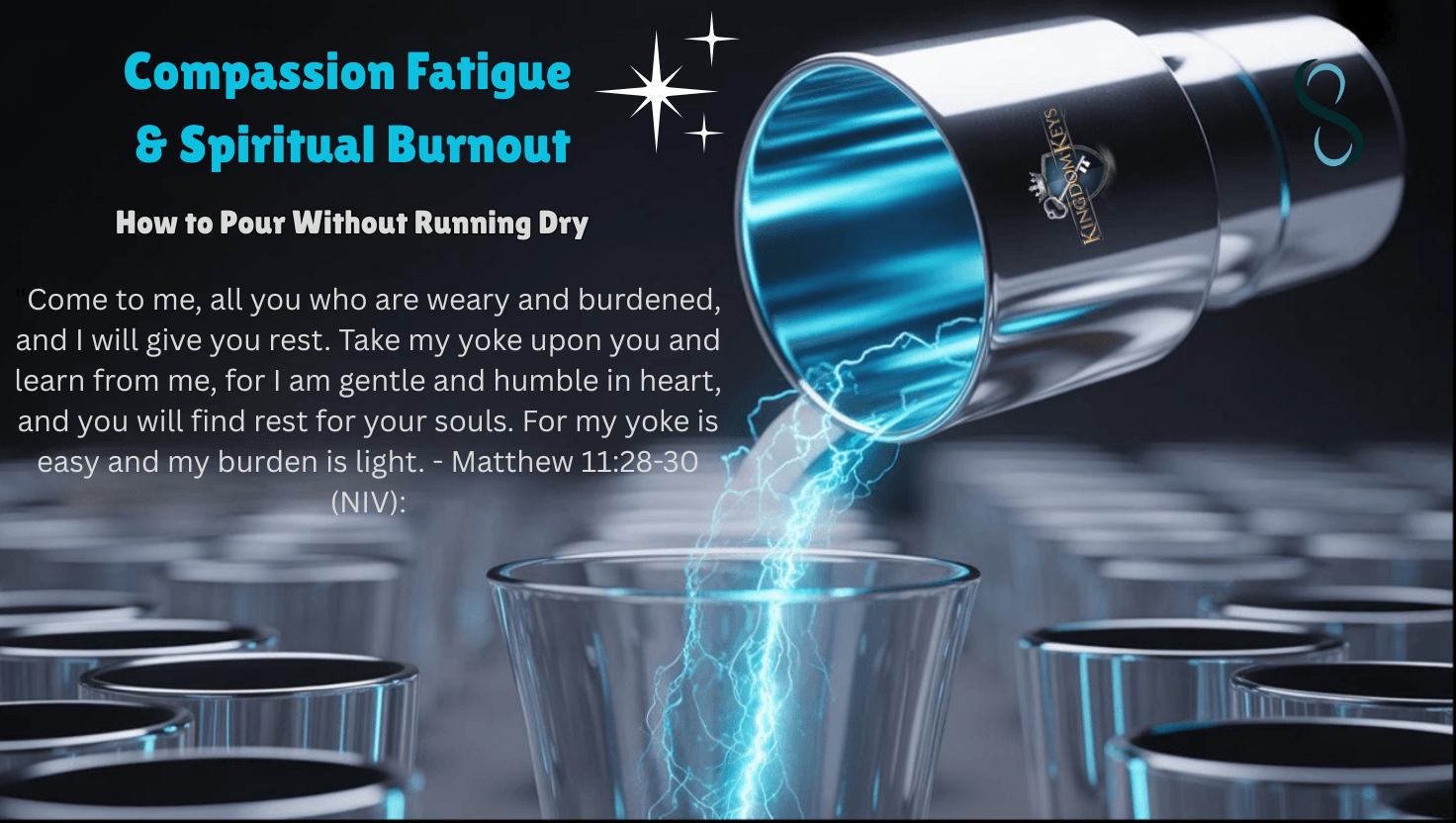
🔋 Compassion Fatigue & Spiritual Burnout
How to Pour Without Running Dry
The Cost of Pouring Without Refilling
There is something deeply beautiful about a heart that desires to give.
To show up for others.
To listen.
To support.
To carry.
To pour.
You may be the one people call when they’re overwhelmed…
The one who holds space when others are breaking…
The one who keeps showing up—even when you’re tired.
And while this reflects compassion, strength, and love…
there is a quiet cost that often goes unspoken.
At some point, giving without refilling begins to take a toll.
Not all at once—
but gradually.
You may start to notice:
• A subtle exhaustion that rest doesn’t seem to fix
• Feeling emotionally drained after helping others
• A heaviness where joy once lived
• A sense of numbness… or quiet resentment you don’t want to admit
• A loss of clarity, sensitivity, or connection in your spiritual life
You’re still showing up…
but something within you feels depleted.
This is where compassion fatigue begins to form.
Not because you don’t care—
but because you’ve cared without restoring.
Not because you’re weak—
but because you’ve been strong for too long without support.
Spiritually, this can become even more confusing.
You may tell yourself:
“I’m doing this for God.”
“I should be able to handle this.”
“I can’t stop now—people need me.”
But slowly…
serving begins to feel like pressure instead of flow.
Responsibility replaces relationship.
And what once felt life-giving… starts to feel like a weight.
Here is the gentle truth:
You were never designed to run on empty.
You were created to live connected to the Source—
not to replace Him.
You are called to serve…
but not to sacrifice your wholeness in the process.
Notice the invitation.
Not “push harder.”
Not “give more.”
Not “carry everything.”
But… come.
Come when you’re weary.
Come when you’re burdened.
Come when you’ve been pouring without being poured into.
Take a moment and gently ask yourself:
Where do I feel drained right now?
Where have I been giving beyond my capacity?
When was the last time I truly allowed myself to receive?
It’s safe to acknowledge this.
It’s safe to feel this.
And it’s safe to begin returning—not just to your calling…
but to the Source that sustains it.
🌊 Understanding Burnout
Compassion Fatigue & Spiritual Depletion
Burnout doesn’t usually arrive with a loud warning.
It builds quietly…
beneath your yes.
beneath your service.
beneath your desire to help, love, and be there for others.
What begins as genuine compassion can slowly turn into exhaustion—
not because your heart is wrong,
but because your rhythm is unsustainable.
🧠 Compassion Fatigue — When Caring Becomes Draining
Compassion fatigue happens when you’ve been giving emotionally for so long
that your inner well begins to run dry.
You may still care…
but you don’t feel it the same way anymore.
Where there was once empathy, now there may be:
• Emotional numbness
• Irritation or overwhelm
• A desire to withdraw or avoid
• Feeling burdened by others’ needs
• Quiet exhaustion from “always being the strong one”
This isn’t a failure of your heart.
It’s a signal from your body and soul:
👉 You’ve been pouring without being replenished.
🔥 Spiritual Burnout — When Serving Replaces Connection
Spiritual burnout goes even deeper.
It happens when your relationship with God begins to feel like a responsibility to perform for Him.
Instead of flowing from connection…
you begin operating from pressure.
You may notice:
• Feeling distant or disconnected from God
• Going through spiritual routines without life or presence
• Serving others while feeling empty inside
• Feeling responsible for outcomes, growth, or people’s healing
• Guilt when you rest… or when you say no
You’re still doing the “right things”…
but something within you feels off.
⚖️ The Hidden Shift
At the core of both compassion fatigue and spiritual burnout
is a subtle but powerful shift:
👉 From overflow → to overextension
👉 From connection → to performance
👉 From trusting God as the Source → to feeling like the source
And this shift is heavy.
Because you were never meant to carry what only God can sustain.
🕊️ The Body & Spirit Connection
Burnout is not just spiritual…
it’s embodied.
When you’re depleted, your nervous system often reflects it:
• Constant tension or fatigue
• Feeling on edge or easily overwhelmed
• Difficulty resting—even when you have time
• Emotional highs and lows
• Mental fog or lack of clarity
Your body is not working against you.
It’s communicating with you.
👉 Something needs to be restored.
This scripture is often used to encourage endurance…
but notice what it also reveals:
👉 Weariness can happen even while doing good.
God is not denying your exhaustion—
He’s inviting you to remain aligned so you don’t lose heart.
Pause and gently reflect:
Where has doing good begun to feel heavy?
Where have I taken on responsibility that isn’t mine?
Have I been serving from connection… or from pressure?
This is not a moment for judgment.
It’s a moment for awareness.
Because awareness opens the door to realignment—
and realignment makes restoration possible.
⚠️ Signs You’re Running on Empty
Recognizing the Signals Before Depletion Deepens
Burnout rarely begins with collapse.
It begins with whispers…
small signals your body, mind, and spirit send—hoping you’ll notice
before they have to speak louder.
Many people miss these signs not because they’re unaware…
but because they’ve learned to push past them.
To keep going.
To stay strong.
To show up no matter what.
But these signals are not interruptions.
They are invitations.
🧠 Emotional & Mental Signals
When you’re running on empty, your inner world often shifts first.
You may notice:
• Feeling easily overwhelmed by things that once felt manageable
• Irritability, frustration, or emotional sensitivity
• Difficulty focusing or making clear decisions
• A sense of mental fatigue or constant “brain fog”
• Wanting to withdraw—even from people you care about
Notice this gently:
👉 This is not you “failing.”
👉 This is your mind asking for space and restoration.
💔 Emotional Disconnection
Sometimes, instead of feeling too much…
you begin to feel less.
You may experience:
• Numbness or emotional flatness
• Lack of motivation or inspiration
• Feeling disconnected from joy, peace, or purpose
• Going through the motions without feeling present
This can be confusing—especially if you’re still doing all the “right” things.
But this is often the heart’s way of protecting itself
when it has been overextended for too long.
🔥 Physical & Nervous System Indicators
Your body keeps the score of what your soul has been carrying.
You might notice:
• Persistent fatigue—even after rest
• Tension in your shoulders, chest, or jaw
• Difficulty relaxing or “turning off”
• Sleep disturbances or waking up still tired
• Feeling wired and exhausted at the same time
Your body is not resisting you.
It’s revealing what needs your attention.
👉 Something within you has been carrying too much for too long.
🕊️ Spiritual Indicators
This is often the most subtle—and the most important.
You may begin to feel:
• Spiritually dry or disconnected
• Less desire to pray, reflect, or be still
• Engaging spiritually, but without depth or presence
• Feeling like you’re doing things for God, but not with Him
• Questioning your purpose, clarity, or direction
This is not a loss of faith.
It’s often a loss of connection through exhaustion.
⚖️ Behavioral Patterns
Burnout doesn’t just affect how you feel—
it affects how you respond and move.
You may find yourself:
• Saying yes when you really need to say no
• Overcommitting and then feeling overwhelmed
• Avoiding rest because it feels unproductive or uncomfortable
• Feeling guilty when you slow down
• Continuing to give—even when you feel depleted
Pause here for a moment:
👉 Where are you overriding your own needs?
👉 Where are you pushing past your own limits?
Notice the language:
He makes you lie down…
He leads you to stillness…
He restores your soul.
Sometimes, rest is not something we choose—
it becomes something we are gently led into… or even stopped for.
Take a quiet moment and ask yourself:
Where have I been ignoring the signals my body and spirit are giving me?
What have I been pushing through that I actually need to pause and honor?
Is it safe for me to slow down… even just a little?
Awareness is not weakness.
It’s wisdom.
And recognizing these signs is not the end—
it’s the beginning of your return to balance, restoration, and sustainable strength.
💧 The Embodied Practice
Serving from Overflow
Healing in this area is not just about recognizing burnout…
It’s about learning a new way of living—
a new rhythm where you no longer give from depletion,
but from overflow.
🌊 What Does It Mean to Serve from Overflow?
Serving from overflow means:
👉 You are filled before you pour
👉 You are connected before you give
👉 You are rested before you respond
It shifts your posture from:
• “I have to show up” → to → “I get to give from fullness”
• “They need me” → to → “God is the Source—I am a vessel”
• “I can’t stop” → to → “I honor both giving and receiving”
This is not about giving less…
It’s about giving differently.
With presence.
With peace.
With sustainability.
🕊️ Returning to the Source First
Before you pour into anyone else…
you return inward.
You return to God.
Not as a routine…
but as a reconnection.
A quiet moment.
A breath.
A pause.
Notice the order:
👉 Remain → then bear fruit
Not produce first…
not strive first…
not exhaust yourself trying to be enough.
Just remain.
Because overflow is not something you force—
it’s something that naturally happens
when you stay connected to the Source.
🌬️ A Simple Embodied Reset Practice
Pause for a moment.
Gently bring your awareness back to your body.
Take a slow breath in…
and release it softly.
Again…
in…
and out…
Now ask yourself:
Where do I feel tension or heaviness right now?
What have I been carrying that isn’t mine?
What do I need in this moment?
Place a hand over your heart if it feels natural.
And gently remind yourself:
👉 I don’t have to carry everything
👉 I am allowed to receive
👉 God is my source—not my striving
Stay here for a few breaths.
Let your body begin to soften.
Let your mind begin to quiet.
⚖️ Creating Rhythms of Overflow
Serving from overflow is not a one-time decision—
it’s a lifestyle rhythm.
It looks like:
• Pausing before responding instead of reacting
• Checking in with your capacity before saying yes
• Taking intentional time to rest without guilt
• Allowing yourself to receive support, care, and presence
• Releasing outcomes and trusting God with what you cannot control
🔄 A Gentle Shift to Practice Daily
Before you give… ask:
👉 Am I grounded or drained?
👉 Am I connected or scattered?
👉 Am I responding from peace… or pressure?
If you feel empty…
That is not a sign to push harder.
That is a signal to return and refill.
🕊️ Living This Out in Real Time
You don’t have to withdraw from your life to practice this.
You begin right where you are.
In conversations.
In responsibilities.
In moments of demand.
When you feel the urge to overextend:
Pause.
Breathe.
Reconnect.
Let your response come from alignment, not urgency.
Let your giving come from overflow, not obligation.
Because the truth is:
You can still serve.
You can still love.
You can still show up fully.
But you no longer have to lose yourself in the process.
Take a moment and gently notice:
Where in my life can I begin shifting from depletion… to overflow?
What would it look like for me to give after being filled?
This is where sustainability begins.
This is where peace returns.
This is where your service becomes life-giving again—
for others… and for you.
📖 Biblical Anchor + Story Integration
Rest, Restoration, and Sustainable Service
One of the most powerful truths we can embrace is this:
God never designed His servants to be sustained by their own strength.
Throughout scripture, we don’t just see people serving…
we see them being restored.
We see moments where heaven doesn’t say “keep going”—
it says rest, receive, and be renewed.
🌿 Elijah — When Burnout Meets Divine Restoration
Elijah was a powerful prophet.
He had just experienced a major spiritual victory—
calling down fire from heaven, confronting opposition, standing boldly in faith.
But immediately after that victory…
He crashed.
Emotionally.
Physically.
Spiritually.
He ran into the wilderness…
exhausted, overwhelmed, and ready to give up.
📖 He came to a broom bush, sat down under it and prayed that he might die. “I have had enough, Lord,”
he said. Then he lay down under the bush and fell asleep. – 1 Kings 19:4–5 (NIV)
Notice this moment.
This wasn’t weakness.
This was burnout.
Even after doing something powerful for God,
Elijah reached a place where he simply couldn’t keep going.
But what’s even more powerful…
Is how God responded.
📖 All at once an angel touched him and said, “Get up and eat.” He looked around, and there by his head was some bread
baked over hot coals, and a jar of water. He ate and drank and then lay down again. – 1 Kings 19:5–6 (NIV)
God didn’t correct him.
God didn’t rebuke him.
God didn’t say “pray harder” or “try again.”
God met him with:
👉 Rest
👉 Nourishment
👉 Gentleness
Before giving Elijah another assignment…
God restored his body.
Before speaking direction…
God provided care.
📖 The angel of the Lord came back a second time and touched him and said, “Get up and eat,
for the journey is too much for you.” So he got up and ate and drank. Strengthened by that food,
he traveled forty days and forty nights. — 1 Kings 19:7–8 (NIV)
Let this truth settle in:
👉 The journey was too much for him… in his current state.
And God acknowledged that.
Not with pressure…
but with provision.
🌊 What This Reveals for You
Elijah’s story shows us:
✔ You can love God deeply and still become exhausted
✔ You can be used powerfully and still need restoration
✔ Burnout does not disqualify you—it reveals your need for replenishment
And most importantly:
👉 God is not asking you to push past your limits
👉 He is inviting you to be sustained by Him
✨ Jesus — The Model of Sustainable Service
Even Jesus—the perfect example of alignment—
did not operate in constant output.
He withdrew regularly.
📖 But Jesus often withdrew to lonely places and prayed. — Luke 5:16 (NIV)
Notice the word:
👉 Often
This was not occasional.
This was a pattern.
Jesus didn’t wait until He was exhausted.
He built rest, solitude, and reconnection into His rhythm.
🌿 Bringing It Together
Elijah shows us:
👉 God restores you when you’re depleted
Jesus shows us:
👉 You can create rhythms that prevent depletion
Both are invitations.
Not to stop serving…
but to serve in a way that is sustainable, supported, and Spirit-led.
Take a moment and gently reflect:
Where am I pushing through when I actually need restoration?
Have I been waiting until burnout to rest… instead of building rest into my rhythm?
What would it look like to trust God to sustain me—not just use me?
You are not alone in this.
And you are not expected to carry what only God can sustain.
🔄 Integration Practice
Rest, Boundaries, Renewal
Awareness is powerful…
but integration is where transformation happens.
This is where you begin to live differently—
not just understand burnout,
but actively shift out of it.
🌿 Returning to a Sustainable Rhythm
Healing from compassion fatigue is not about doing less…
It’s about living in a rhythm that includes:
👉 Giving
👉 Resting
👉 Receiving
👉 Restoring
Not one without the others.
Take a moment and notice:
Where has my life become all giving…
with little to no restoring?
This is where your new rhythm begins.
🕊️ Practice 1: The Sacred Pause
Before responding to a need, request, or responsibility…
Pause.
Just for a moment.
Take a breath.
And gently ask:
👉 Do I have the capacity for this right now?
👉 Am I responding from peace… or pressure?
👉 Is this mine to carry?
If the answer is no…
It is safe to pause longer.
It is safe to wait.
It is safe to say no.
⚖️ Practice 2: Honoring Boundaries Without Guilt
Boundaries are not barriers to love.
They are protectors of alignment.
You are allowed to say:
• “I’m not available for that right now.”
• “I need time to rest and restore.”
• “I can support you—but I cannot carry this for you.”
This doesn’t make you selfish.
It makes your giving sustainable.
📖 Very early in the morning, while it was still dark, Jesus got up, left the house and went off to a solitary place,
where he prayed. — Mark 1:35 (NIV)
Even with people needing Him…
even with demands surrounding Him…
Jesus still chose intentional withdrawal.
Not out of avoidance—
but out of alignment.
Boundaries are not about pushing people away.
They are about staying connected to God so what you give remains pure, present, and life-giving.
💧 Practice 3: Daily Receiving Time
If you are always giving…
you must also create space to receive.
This can be simple:
• Sitting in stillness for a few minutes
• Breathing slowly and intentionally
• Listening instead of speaking
• Allowing yourself to be supported
• Letting God pour into you without agenda
Ask yourself:
👉 When do I allow myself to receive… without performing?
Receiving is not passive.
It is spiritual alignment.
🌊 Practice 4: Release What Isn’t Yours
One of the biggest causes of burnout
is carrying what was never yours to carry.
Take a moment and notice:
What am I holding right now that belongs to someone else?
What outcomes am I trying to control?
What burdens have I taken on that God never asked me to carry?
Now, gently release it.
You might say within:
👉 I release what is not mine
👉 I trust God with what I cannot control
👉 I return to my place of alignment
📖 Come to me, all you who are weary and burdened, and I will give you rest. — Matthew 11:28 (NIV)
Rest is not found in doing more.
It’s found in releasing what was never yours to hold alone.
🔁 Practice 5: Build Rhythms, Not Rescue Moments
Many people only rest when they’re forced to.
But healing comes when you build rest into your life consistently.
This might look like:
• Scheduling moments of stillness into your day
• Creating space between responsibilities
• Saying no before you become overwhelmed
• Checking in with your energy throughout the day
• Returning to God in small, consistent ways
Ask yourself:
👉 What small rhythm can I begin today that supports my restoration?
🌿 Bringing It All Together
You don’t need to change everything at once.
Start gently.
Start honestly.
Start with one small shift.
Notice where you feel drained…
and choose to respond with care.
Notice where you feel pressure…
and choose to pause instead of push.
Notice where you’ve been giving beyond your capacity…
and allow yourself to receive again.
Because your calling does not require your exhaustion.
And your purpose does not demand your depletion.
Take a quiet moment and ask:
What is one way I can honor both my calling and my capacity today?
This is how you begin to live differently.
This is how you return to balance.
This is how you move from burnout… to sustainable, Spirit-led living.
🕊️ Guided Prayer / Restoration Activation
Returning to the Source… Receiving What You Need
This is a moment to pause…
Not to strive.
Not to perform.
Not to say the “right” words.
But to be still… and receive.
If it feels comfortable, gently close your eyes…
or soften your gaze.
Take a slow breath in…
and release it softly.
Again…
in…
and out…
Let your shoulders drop.
Let your body settle.
🌬️ Centering Moment
Bring your awareness to your heart.
Notice what you’re feeling…
without judgment.
If there’s heaviness… let it be there.
If there’s fatigue… acknowledge it.
If there’s resistance… gently soften around it.
You don’t have to carry this alone.
🙏 Guided Prayer
Father…
I come to You just as I am—
not as who I think I need to be,
but as I truly am in this moment.
You see where I’ve been giving…
You see where I’ve been stretching myself beyond my limits…
You see the places where I feel tired, overwhelmed, or empty.
And right now… I release the need to hold it all together.
I acknowledge that I have been carrying things
that were never mine to carry alone.
Responsibilities…
expectations…
emotional weight…
I lay them down before You.
📖 Cast your cares on the Lord and he will sustain you; he will never let the righteous be shaken. — Psalm 55:22 (NIV)
You don’t have to manage everything.
You don’t have to sustain everything.
God is your sustainer.
🙏 Continue Prayer
Father, I ask You now…
Restore what has been drained.
Refresh what has grown weary.
Reawaken what feels distant within me.
Where I have been striving…
teach me how to rest.
Where I have been over-giving…
teach me how to receive.
Where I have felt responsible for outcomes…
help me to trust You again.
I choose to return to You as my Source.
Not just in words…
but in how I live, how I give, and how I rest.
📖 Those who hope in the Lord will renew their strength. They will soar on wings like eagles;
they will run and not grow weary, they will walk and not be faint. — Isaiah 40:31 (NIV)
🕊️ Prayer Reflection
Renewal is not something you force.
It is something you receive…
as you place your hope back in Him.
🙏 Final Activation
Right now… take a slow breath in.
And as you exhale…
imagine releasing everything you’ve been holding.
Again… breathe in…
And as you exhale…
receive peace.
Gently say within yourself:
👉 I release what is not mine to carry
👉 I receive God’s rest and restoration
👉 I return to the Source that sustains me
Let yourself sit here for a few more breaths.
No rushing.
No pressure.
Just presence.
🌿 Closing Moment
When you’re ready, gently bring your awareness back.
Notice how you feel…
even if it’s just a small shift.
That’s enough.
You can return to this moment anytime.
You can return to this place of restoration again and again.
Because God’s presence is not something you have to chase…
It’s something you can return to.
✍️ Reflection & Awareness Prompts
Gently Noticing… Honestly Acknowledging… Intentionally Realigning
This is your space to slow down and listen inward.
Not to analyze…
not to judge…
but to become aware.
Because awareness is where healing begins—
and honest reflection is what allows realignment to take root.
Take a breath…
And as you move through these prompts,
allow your responses to be real, unfiltered, and compassionate.
You don’t need perfect answers.
Just truthful ones.
🌿 Awareness of Your Current State
• Where do I feel the most drained right now—emotionally, physically, or spiritually?
• When did I first begin noticing this exhaustion?
• What does “running on empty” feel like in my body?
⚖️ Patterns of Over-Giving
• Where in my life am I consistently giving more than I have capacity for?
• Who or what do I feel responsible for that may not actually be mine to carry?
• Do I tend to say yes out of love… or out of pressure, fear, or guilt?
💔 Relationship with Rest & Receiving
• How do I truly feel about rest? Do I resist it, avoid it, or embrace it?
• When I take time for myself, do I feel peace… or guilt? Why?
• When was the last time I allowed myself to receive—without trying to give back?
🕊️ Spiritual Alignment Check
• Am I currently serving from connection with God… or from obligation?
• Do I feel spiritually nourished… or spiritually drained?
• When I spend time with God, does it feel life-giving—or like something I “have to do”?
🔄 Boundaries & Capacity
• Where do I need to create or strengthen a boundary in my life?
• What am I afraid might happen if I begin to say no?
• What would honoring my capacity actually look like in this season?
🌊 Releasing & Realigning
• What am I holding onto that I need to release?
• What expectations—of myself or others—are weighing me down?
• What would it feel like to trust God with what I cannot control?
💧 Moving Toward Overflow
• What does “serving from overflow” look like for me personally?
• What small shift can I begin making today to support my restoration?
• Where in my life is God inviting me to slow down, reconnect, and receive?
🕊️ Closing Reflection
Take a moment and place your attention back on your heart.
Ask yourself:
What is one truth from this reflection that I don’t want to ignore?
Let that truth stay with you.
Not as pressure…
but as guidance.
There is no rush.
There is no timeline you must meet.
This is a journey of returning—
to balance, to alignment, and to sustainable wholeness.
🧰 Tools for Sustainable Spiritual Living
Practices That Protect Your Peace and Preserve Your Calling
Sustainability doesn’t happen by accident.
It’s built through intentional tools and rhythms
that keep you connected, grounded, and restored—
even while you continue to serve.
These are not rigid rules…
They are supports—
gentle structures that help you live from overflow
instead of exhaustion.
🌿 1. The Daily Check-In
Stay aware of your inner state
Before you move through your day—or as you transition between moments—pause and ask:
👉 How do I feel right now?
👉 Am I grounded or overwhelmed?
👉 What do I need in this moment?
This simple awareness keeps you from drifting into depletion unnoticed.
It helps you respond with intention,
instead of reacting from exhaustion.
🌊 2. The “Pause Before Yes” Practice
Protect your capacity
Before saying yes to a request, opportunity, or responsibility:
Pause.
Breathe.
Ask:
👉 Do I have the capacity for this right now?
👉 Is this aligned… or am I responding from pressure?
👉 What would honoring my energy look like here?
This tool alone can prevent countless moments of overextension.
⚖️ 3. Boundaries That Honor Your Calling
Say no without guilt
Boundaries are not limitations.
They are alignment tools.
Practice phrases like:
• “I’m not able to commit to that right now.”
• “I need time to rest and restore.”
• “I can support you—but I cannot carry this for you.”
📖 Above all else, guard your heart, for everything you do flows from it. — Proverbs 4:23 (NIV)
🕊️ Anchor Reflection
Guarding your heart is not selfish.
It’s essential.
Because everything you give flows from what you carry within.
💧 4. Intentional Receiving Time
Let yourself be poured into
If you are always giving,
you must intentionally create space to receive.
This could look like:
• Quiet time with God—without agenda
• Sitting in stillness and breathing deeply
• Listening to worship or peaceful sounds
• Allowing someone else to support or encourage you
Ask yourself:
👉 When do I allow myself to receive… without needing to give back?
Receiving is not weakness.
It is alignment with divine flow.
🌬️ 5. Nervous System Reset Moments
Calm your body to restore clarity
Your body needs support just as much as your spirit.
Simple resets:
• Slow, deep breathing (in through the nose, out through the mouth)
• Relaxing your shoulders and jaw
• Stepping away from stimulation for a few minutes
• Placing your hand over your heart and grounding yourself
These small moments signal safety to your body
and create space for peace to return.
🔄 6. Release & Return Practice
Let go of what isn’t yours
Throughout your day, when you feel overwhelmed:
Pause and gently say within:
👉 I release what is not mine to carry
👉 I return to God as my Source
👉 I trust Him with what I cannot control
📖 Cast all your anxiety on him because he cares for you. — 1 Peter 5:7 (NIV)
🕊️ Anchor Reflection
You are not meant to carry everything.
You are meant to walk with God—not replace Him.
🌿 7. Rhythms of Rest (Not Just Emergency Rest)
Build restoration into your life
Don’t wait until you’re exhausted to rest.
Create rhythms like:
• Short pauses throughout your day
• Designated time to unplug and be still
• Moments of reflection before or after serving others
• Giving yourself permission to stop before you’re depleted
Ask yourself:
👉 Where can I build rest into my rhythm… before I reach burnout?
🌊 Bringing It All Together
You don’t need to use every tool at once.
Start with one.
Practice it gently.
Let it become natural.
Notice where you feel drained…
and respond with awareness.
Notice where you feel pressure…
and choose to pause.
Notice where you’ve been over-giving…
and allow yourself to receive.
Because sustainable spiritual living is not about doing more.
It’s about living in a way that keeps you connected to the Source—
so what you give remains life-giving, not life-draining.
Take a quiet moment and ask:
Which one of these tools do I need most right now?
Let that be your starting place.
💬 Closing Encouragement + Final Declaration
You Are Allowed to Be Whole While You Serve
Take a moment… and just breathe.
You’ve walked through awareness.
You’ve acknowledged what’s been heavy.
You’ve recognized where you’ve been giving beyond your capacity.
And now…
You stand at a gentle turning point.
🌿 A Truth to Carry With You
You were never called to exhaust yourself to prove your love.
You were never asked to carry what only God can sustain.
You were never designed to live disconnected from the very Source that gives you life.
Your compassion is a gift.
Your willingness to serve is beautiful.
Your heart to show up for others matters deeply.
But you are not meant to lose yourself in the process.
🕊️ A Gentle Reframing
Rest is not a reward for finishing everything.
Rest is a requirement for staying aligned.
Boundaries are not a rejection of others.
They are a protection of what God placed within you.
Receiving is not weakness.
It is part of the divine exchange.
And burnout…
is not a sign that you’ve failed.
It’s a signal that it’s time to return.
📖 Truly my soul finds rest in God; my salvation comes from him. — Psalm 62:1 (NIV)
🕊️ Final Reflection
Your soul already knows where rest is found.
Not in doing more.
Not in trying harder.
But in returning… again and again…
to God as your Source.
✨ Final Declaration
Take a slow breath in…
And as you exhale, gently speak these words—out loud or within:
I release the need to carry everything.
I am not the source—God is.
I honor my capacity and care for my soul.
I give from overflow, not from depletion.
I allow myself to rest without guilt.
I receive as freely as I give.
I trust God to sustain what He has called me to.
I return to alignment, peace, and wholeness.
🌊 Final Encouragement
You don’t have to get this perfect.
You don’t have to change everything overnight.
Just begin…
With one moment of awareness.
One honest pause.
One choice to rest when you need it.
Because your calling is not at risk when you slow down.
Your clarity is restored.
Your peace is protected.
And your service becomes life-giving again.
You are allowed to be whole.
You are allowed to be sustained.
You are allowed to walk this journey—
not as one who is constantly pouring out…
but as one who remains connected
to the endless Source within.
📬 Continue Your Journey in Truth
Move From Awareness… Into Ongoing Alignment
You’ve taken a powerful step.
You didn’t just read—you recognized,
you reflected,
and you allowed truth to meet you where you are.
But this is not the end of the journey…
It’s an invitation to go deeper.
Stay Connected & Keep Growing
Transformation happens through consistent alignment, not one-time moments.
If this teaching resonated with you, stay connected and continue receiving:
• New teachings that bring clarity and restoration
• Guided practices to help you live from overflow
• Encouragement to support your spiritual and emotional well-being
• Updates on new Kingdom Keys resources, courses, and experiences
📩 Sign Up for the Kingdom Chronicle
Be part of the Kingdom Keys community and receive ongoing insight, guidance, and support for your journey.
Submit your email address below
🕊️ Go Deeper With Structured Guidance
When you're ready to explore deeper:
The Kingdom Keys Academy of Divine Transformation offers structured teachings,
guided practices, and immersive experiences designed to help you:
✔ Strengthen discernment
✔ Rebuild identity and inner confidence
✔ Practice alignment in daily life
✔ Embody truth in a real and lasting way
💬 Engage with the Community
Connect with others walking a similar path…
Share insights, ask questions, and grow together in a space centered on truth and transformation.
🌿 A Final Invitation
There is no pressure here.
No rush to become anything.
Just an open invitation…
to continue returning…
to continue practicing…
to continue becoming aligned with what is true.
And when you’re ready…
Your next step will meet you.



Support Kingdom Keys
Help Us Continue Providing Life-Changing Resources
If this page has spoken to your heart…
If you’ve found clarity, encouragement, or a deeper sense of truth…
And if you believe in the mission of Kingdom Keys—
to provide transformational resources that help individuals
heal, grow, and realign with their true identity—
We invite you to consider supporting this work.
🌿 Why Your Support Matters
Every contribution—big or small—helps us:
✨ Create more teachings like this one
✨ Provide free resources to those who need them most
✨ Develop deeper tools, courses, and guided experiences
✨ Expand the reach of Kingdom Keys to impact more lives
🕊️ A Shared Mission
Kingdom Keys exists to:
✔ Help individuals return to truth
✔ Bridge understanding from tradition into transformation
✔ Offer real tools for healing, growth, and alignment
Your support helps make that possible.
✨ Ways to Support
You can support Kingdom Keys in a way that feels right for you:
💝 One-time contribution
💝 Ongoing monthly support
💝 Sharing this page with someone who may need it
| Start Your Journey | • Embodied Healing Practices | Healed & Whole| The Guided Path | Truth Foundations | Mind Renewal

May every key unlock new levels of faith, wisdom, and divine alignment within you.
“Thank you for being part of the Kingdom Keys family.”
© 2025 Kingdom Keys. All Rights Reserved.