
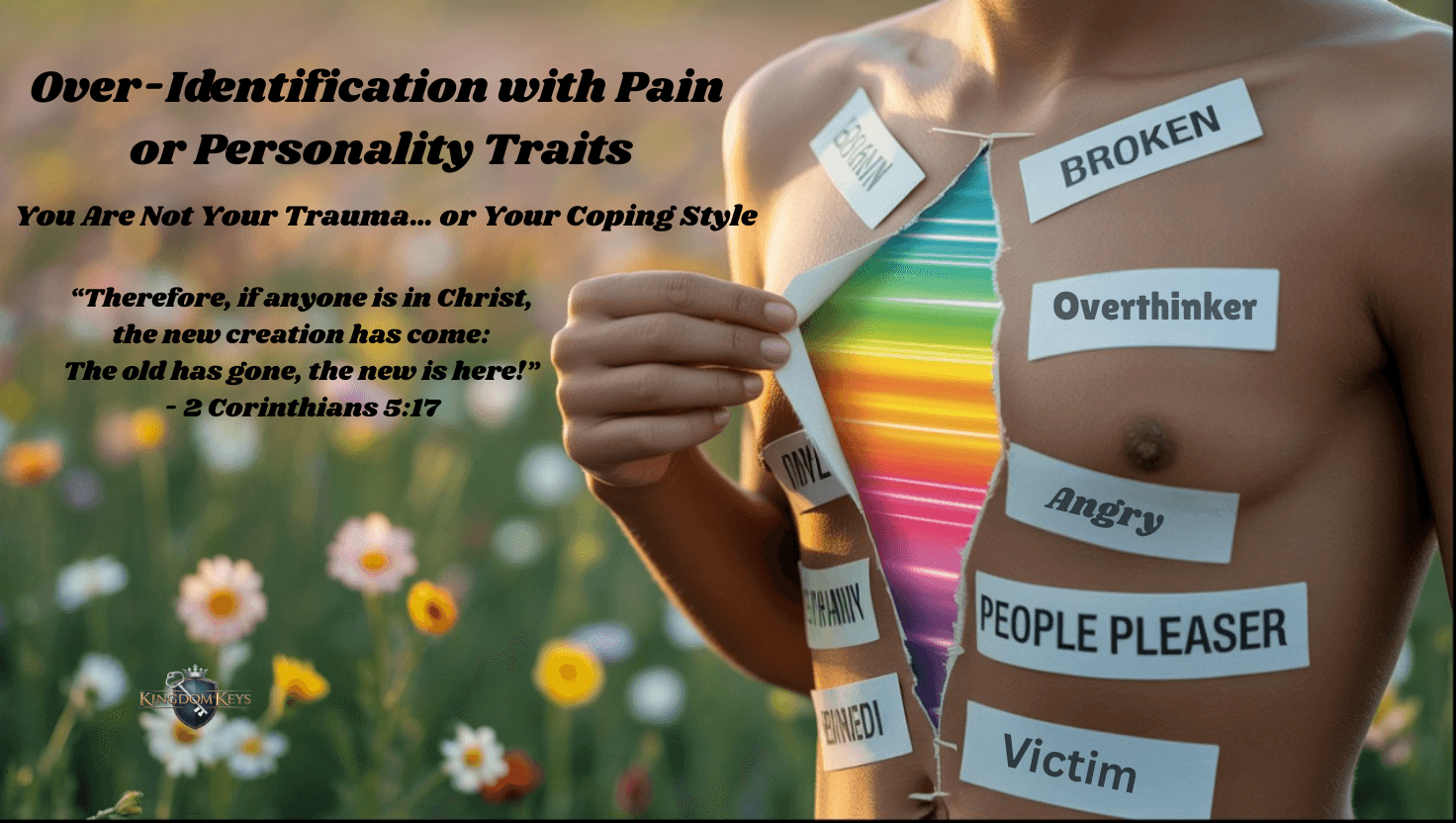
🔓 Over-Identification with Pain or Personality Traits
You Are Not Your Trauma… or Your Coping Style
There are ways we learn to survive…
that slowly begin to feel like who we are.
Not because they were ever meant to define us—
but because we’ve lived with them for so long.
After years of navigating pain, rejection, pressure, or emotional strain,
it becomes natural to explain ourselves through what we’ve experienced:
“I’m just an anxious person.”
“I’ve always been this way.”
“I’m the one everyone depends on.”
“That’s just how I am.”
These words don’t usually come from a place of deception…
they come from lived experience.
But over time, something subtle begins to happen:
What started as a response…
becomes a label.
And what was once a pattern…
begins to feel like identity.
🌿 When Patterns Feel Permanent
Many of the traits we now call “personality”
were never originally who we were created to be.
They were responses.
Ways to adapt.
Ways to cope.
Ways to stay safe in environments that required adjustment.
For some, it looked like becoming overly responsible.
For others, it meant staying quiet, staying guarded, or staying in control.
And in truth—
those patterns may have served you in moments when you needed them.
So this is not about rejecting your past…
and it is not about judging how you survived.
It is about recognizing something deeper:
👉 What you learned to do is not the same as who you are.
🕊️ The Quiet Confusion
When patterns are repeated long enough,
they no longer feel like something we’re doing…
They feel like something we are.
“I am anxious.”
“I am broken.”
“I am too much.”
“I am not enough.”
“I am the strong one.”
“I am the fixer.”
“I am the one who holds it all together.”
But these are not identities—
they are interpretations.
And interpretations can be reshaped
when truth is revealed.
✨ A Gentle Awakening
This moment is not about stripping anything away harshly…
It is about gently opening your awareness
to a possibility you may not have fully considered:
👉 You may have been carrying an identity
that was formed in response to life—
not rooted in your true design.
And if that’s true…
Then you are not limited to it.
🌅 The Beginning of Separation
There is a sacred distinction that begins here:
✔ What happened to you
✔ How you adapted
✔ Who you truly are
These are not the same.
And healing begins the moment
you no longer confuse them.
🗝️ The Invitation Forward
This journey is not about becoming someone new through effort…
It is about returning to who you’ve always been
beneath the layers of adaptation, survival, and self-definition.
And as that truth begins to unfold…
You’ll discover something freeing:
You were never your trauma.
You were never your coping style.
You were never the label.
You are still whole.
Still created with intention.
Still defined by something greater.
🧠 How Identity Becomes Attached to Pain
Understanding How Survival Patterns Become Self-Definition
Identity is not something we consciously choose in moments of pain…
it’s something that quietly forms over time.
Not through intention—
but through repetition.
🔄 The Pattern Beneath the Pattern
When an experience happens once,
it creates an impression.
When it happens repeatedly,
it begins to form a pattern.
And when that pattern goes unchallenged…
it starts to shape belief.
“I keep feeling this way…”
“People always treat me like this…”
“This keeps happening in my life…”
Over time, the mind begins to draw a conclusion:
👉 “This must be who I am.”
🧩 From Experience to Identity
What many don’t realize is that identity often forms through a quiet progression:
Experience → Emotional Response → Pattern → Belief → Identity
A child is repeatedly overlooked →
They feel unseen →
They become quiet or withdrawn →
They begin to believe, “I don’t matter” →
They grow into, “I’m just a quiet person”
Someone faces repeated rejection →
They feel unworthy →
They become people-pleasing →
They believe, “I have to earn love” →
They adopt, “I’m just the one who gives more”
And none of this happens with conscious awareness.
It forms beneath the surface—
as a way to make sense of pain and stay emotionally safe.
🛡️ The Role of Protection
These patterns are not random…
they are protective.
The mind and heart are designed to adapt in order to avoid further pain.
So they create strategies like:
✔ Staying small to avoid rejection
✔ Staying strong to avoid vulnerability
✔ Staying in control to avoid uncertainty
✔ Staying quiet to avoid conflict
And over time, those strategies stop feeling like choices…
They start feeling like identity.
🕊️ What Needs to Be Seen Clearly
This is the turning point:
👉 Just because something feels natural…
does not mean it is original to who you are.
👉 Just because a pattern is familiar…
does not mean it is your identity.
👉 Just because it has been with you for years…
does not mean it was meant to stay.
✨ A Compassionate Realization
Nothing about this process makes you weak.
In fact, it reveals something powerful:
You adapted.
You learned.
You found ways to navigate what you didn’t yet have the tools to process.
But now…
You have the awareness to see it differently.
And awareness is where identity begins to shift.
🌿 The Invitation Forward
Instead of asking:
“Why am I like this?”
You can begin asking:
👉 “What did I learn… that I now believe is who I am?”
That one shift opens the door
to separation…
to clarity…
and eventually, to freedom.
🔍 Common Identity Attachments
Recognizing the Labels That May Not Truly Be You
As patterns repeat over time,
they often become the language we use to describe ourselves.
Not because they are true…
but because they have been consistent.
And consistency can feel like identity.
🧩 The Labels We Learn to Carry
Many of us have adopted identity statements that sound like this:
✔ “I’m just an anxious person”
✔ “I’m always overthinking things”
✔ “I’m the one who takes care of everyone”
✔ “I’m not good with emotions”
✔ “I’m too sensitive”
✔ “I’m too much… or not enough”
✔ “I’m the strong one—I don’t need help”
✔ “I’m just not confident”
These statements may feel honest…
but they are often rooted in patterns—not truth.
🌿 When Description Becomes Definition
There is nothing wrong with acknowledging what you’ve experienced.
The problem begins when:
👉 A temporary pattern becomes a permanent label
👉 A learned behavior becomes a fixed identity
👉 A coping mechanism becomes “who you are”
“I feel anxious sometimes”
becomes
“I am an anxious person”
“I learned to take care of others”
becomes
“That’s just who I am”
And slowly… without realizing it…
you begin living inside a definition
that was never meant to define you.
🕊️ What These Labels Often Reveal
Behind every identity label…
there is usually a deeper story:
“I’m anxious” → I learned to stay alert to feel safe
“I’m a people pleaser” → I learned to earn acceptance
“I’m emotionally distant” → I learned to protect my heart
“I’m the strong one” → I learned I couldn’t depend on others
“I’m not enough” → I internalized rejection or comparison
These are not flaws in your design…
They are adaptations formed through experience.
⚠️ The Hidden Cost of Misidentification
When we attach identity to these patterns, something subtle happens:
We stop questioning them.
We stop challenging them.
We stop believing change is possible.
Because if “this is just who I am”…
then there is nothing to shift.
And that belief quietly keeps us bound
to patterns we were never meant to live in permanently.
✨ A Gentle Reframe
What if instead of saying:
“I am this way…”
You began to say:
👉 “I learned this pattern… but it is not my identity.”
👉 “This has been my experience… but it is not my definition.”
👉 “This has been familiar… but it is not who I truly am.”
This small shift creates space—
space for truth,
space for growth,
space for transformation.
🌅 The Beginning of Clarity
You are not being asked to reject yourself…
You are being invited to see yourself more clearly.
To recognize:
✔ What was learned
✔ What was adapted
✔ What was carried
…without confusing it
for who you were created to be.
⚖️ Identity vs Adaptation
Separating Who You Are from What You Learned to Be
There comes a moment in the healing journey
where you begin to see something clearly:
Not everything that feels like “you”…
actually is you.
Some things were learned.
Some things were developed.
Some things were necessary for a season.
But they were never meant to become your identity.
🧩 Two Very Different Realities
To move forward in truth,
we must gently separate two things that often get blended together:
🔹 Identity
Who you truly are at your core
—God-given, unchanging, whole.
🔹 Adaptation
What you learned to become
in response to life, pain, and environment.
🌿 What Identity Is Rooted In
Your true identity is not fragile.
It is not formed by circumstances.
It is not shaped by how others treated you.
It is rooted in truth.
It is grounded in how you were created—
whole, purposeful, and deeply valued.
Even if it has been covered…
it has never been lost.
🛡️ What Adaptation Is Formed From
Adaptation, on the other hand, is incredibly intelligent—
but it is situational.
It develops in response to:
Pain
Rejection
Fear
Pressure
Emotional needs not being met
It asks questions like:
“How do I stay safe?”
“How do I stay accepted?”
“How do I avoid being hurt again?”
And then it builds patterns around those answers.
⚠️ When the Lines Get Blurred
The challenge is not that adaptation exists…
The challenge is when adaptation becomes identity.
When:
“I learned to stay quiet”
becomes
“I’m just a quiet person”
“I learned to take care of everyone”
becomes
“That’s just who I am”
“I learned to stay guarded”
becomes
“I don’t connect with people”
And over time…
you begin living from a version of yourself
that was shaped by survival—not truth.
🕊️ The Truth That Sets You Free
You are not being asked to reject what you learned…
You are being invited to recognize it for what it is.
👉 It was a response
👉 It was a strategy
👉 It was a season
But it is not your identity.
✨ A Restoring Perspective
Think of it this way:
Adaptation is like clothing you wore
for a particular environment.
It served a purpose.
It provided protection.
But it was never meant to become your skin.
🌅 The Power of Separation
The moment you can say:
👉 “This is something I learned… not who I am”
…everything begins to shift.
Because what is learned can be unlearned.
What is adopted can be released.
What is practiced can be replaced.
But what is true…
remains.
📖 “Then you will know the truth, and the truth will set you free.” — John 8:32
🗝️ The Invitation
You don’t have to fight your patterns…
and you don’t have to shame your past.
You simply have to see clearly:
Who you are…
and what you learned to be
are not the same.
And in that clarity—
freedom begins.
📖 Biblical Anchor Story – Gideon
From Misidentification to Divine Identity
There is a powerful moment in Scripture
that captures this entire journey of identity and misidentification.
It’s found in the story of Gideon.
🌾 A Man Defined by His Circumstances
When we first meet Gideon,
he is not standing in strength or confidence.
He is hiding.
Threshing wheat in a winepress—
a place not designed for harvesting,
but chosen out of fear.
Why?
Because the Midianites had oppressed Israel so severely
that survival required hiding what little they had.
Gideon wasn’t acting out of boldness…
he was responding to pressure.
To fear.
To limitation.
To what life had conditioned him to expect.
🧠 The Identity He Carried
When the angel of the Lord appears to Gideon,
he greets him in a way that seems almost… out of place:
“The Lord is with you, mighty man of valor.”— Judges 6:12
But Gideon doesn’t recognize himself in those words.
His response reveals the identity he has accepted:
“My clan is the weakest…and I am the least in my family.”— Judges 6:15
Do you see the disconnect?
God calls out strength.
Gideon responds with limitation.
God speaks identity.
Gideon speaks adaptation.
⚖️ Misidentification in Motion
Gideon had come to define himself by:
✔ His environment
✔ His family position
✔ His current circumstances
✔ His perceived lack
In other words…
He saw himself through what he had experienced—
not through who he was created to be.
And this is where so many find themselves:
Living from a self-definition
that was shaped by pressure, pain, or limitation.
🕊️ God Speaks to Who You Are
What’s powerful is this:
God never argued with Gideon’s feelings…
but He also never agreed with his identity.
He didn’t say,
“You’re right—you’re weak.”
He said, in essence:
👉 “Go in the strength you have.”
👉 “I will be with you.”
👉 “You are who I said you are.”
God spoke to the truth of Gideon’s identity—
even while Gideon was still learning to see it.
✨ The Shift Begins
Gideon didn’t transform overnight.
He questioned.
He doubted.
He asked for confirmation.
And yet…
Step by step,
as he responded to God’s voice rather than his old identity,
something began to change.
Not who he was—but how he saw himself.
🌅 A Mirror for the Seeker
Gideon’s story is not just history…
It’s a reflection.
Because many today are doing exactly what Gideon did:
✔ Hiding in places shaped by fear
✔ Defining themselves by limitation
✔ Speaking identities formed through experience
✔ Struggling to believe something greater is true
And yet…
God is still speaking:
👉 Not to what you’ve been through
👉 Not to what you’ve learned to believe
👉 But to who you truly are
📖 “The Lord is with you, mighty man of valor.”— Judges 6:12
🗝️ The Invitation
What if the way you’ve been seeing yourself
is not the full truth?
What if, like Gideon…
There is a deeper identity being spoken over you—
one that hasn’t changed,
even if it hasn’t yet been fully seen?
Because God does not define you
by your lowest moment…
He calls you
by your true design.
🕊️ God Speaks to Who You Are—Not What You’ve Been
Rediscovering Your True Identity Through His Voice
There is a voice that many have learned to listen to…
The voice of experience.
The voice of past pain.
The voice of repeated patterns.
The voice that says:
“This is just who you are.”
“This is how you’ve always been.”
“This is what you’ll always struggle with.”
And over time, that voice can begin to feel like truth.
🧠 The Voice Formed by Experience
When identity is shaped by what we’ve been through,
our inner dialogue often reflects:
✔ What went wrong
✔ What didn’t work
✔ What hurt
✔ What we had to become to cope
It speaks in conclusions like:
“I’m not strong enough”
“I’m always going to struggle with this”
“I’m just wired this way”
And because these thoughts are familiar…
they feel accurate.
🕊️ The Voice of Truth
But God does not speak from your past experiences.
He speaks from truth.
He speaks from design.
He speaks from purpose.
He speaks from who you are—beneath everything you’ve been through.
And His voice sounds different.
Not condemning…
Not limiting…
Not defining you by your worst moments.
Instead, He calls out what is true—even when it’s not yet visible.
✨ Speaking Identity, Not Dysfunction
Just like with Gideon…
God did not speak to fear—
He spoke to courage.
He did not speak to weakness—
He spoke to strength.
He did not define Gideon by where he was hiding…
He defined him by who he truly was.
And He does the same with you
.
🌿 What This Means for You
It means:
👉 God is not calling you “anxious”
👉 He is not calling you “broken”
👉 He is not calling you “too much” or “not enough”
Those may be experiences you’ve had…
but they are not names He has given you.
Instead, He calls you:
✔ Whole
✔ Chosen
✔ Capable
✔ Loved
✔ Renewed
✔ Complete in Him
Even if you are still in the process of becoming aware of it.
⚠️ Why This Can Feel Unfamiliar
Sometimes, the truth can feel… unfamiliar.
Not because it isn’t true—
but because it hasn’t been the voice you’ve listened to the longest.
If you’ve spent years hearing:
“You’re not enough…”
Then hearing:
“You are complete”
may feel difficult to receive at first.
And that’s okay.
This is not about forcing belief—
it’s about allowing truth to be introduced…
and gently received.
🌅 Learning to Hear Differently
Part of identity restoration
is learning to recognize the difference between:
✔ The voice shaped by experience
and
✔ The voice rooted in truth
One reminds you of what you’ve been through.
The other reveals who you truly are.
📖 “So God created mankind in His own image, in the image of God He created them…” — Genesis 1:27
🗝️ The Invitation
What if the thoughts you’ve accepted about yourself
are not the final word?
What if there is another voice—
steady, true, and unchanging—
calling you into a deeper awareness of who you are?
Because God does not define you
by your past patterns…
He calls you
according to your true identity.
And as you begin to listen…
Everything begins to realign.
🌿 Releasing False Labels
Letting Go of What Was Never Truly You
There is a quiet freedom that begins to emerge
when you realize:
You don’t have to carry every label
you’ve ever believed about yourself.
Some of them were given to you.
Some of them were formed through experience.
Some of them were conclusions you made
in moments when you were trying to make sense of pain.
But not all of them are true.
🕊️ Release Is Not Rejection
Letting go of a label
is not the same as rejecting yourself.
It’s not denying what you’ve felt.
It’s not pretending certain patterns didn’t exist.
It’s simply recognizing:
👉 “This is something I experienced… not who I am.”
And in that recognition,
you create space for truth to take its place.
🌿 Seeing the Label for What It Is
Before something can be released,
it must first be seen clearly.
Not as identity…
but as a label that was attached over time.
“I’m anxious”
becomes
👉 “I learned to stay alert to feel safe”
“I’m not enough”
becomes
👉 “I internalized moments where I felt unseen or unvalued”
“I’m the strong one”
becomes
👉 “I learned to carry more than I should have had to”
And suddenly…
What once felt like identity
becomes something you can gently loosen your grip on.
✨ The Power of Gentle Detachment
Release doesn’t happen through force.
It happens through awareness…
through truth…
through a willingness to no longer agree
with what isn’t aligned.
You don’t have to fight the label.
You simply stop reinforcing it.
Instead of saying:
“I am this…”
You begin to say:
👉 “This has been my experience… but it is not my identity.”
And over time, that shift becomes freedom.
🛑 Ending the Agreement
Every label you’ve carried
has been reinforced by agreement.
Not intentionally—
but through repetition.
Through thoughts like:
“This is just how I am”
“This will never change”
“This is part of me”
But what you agree with…
you empower.
And what you gently stop agreeing with…
begins to lose its hold.
🌅 Making Space for Truth
As you release what is not true…
You don’t become empty.
You become open.
Open to truth.
Open to clarity.
Open to a deeper awareness of who you are.
Because when false labels fall away…
they don’t leave you with less.
They reveal what was always there beneath them.
📖 “You were taught… to put off your old self…and to put on the new self, created to be like God
in true righteousness and holiness.” — Ephesians 4:22–24
🗝️ The Invitation
You don’t have to carry
what was never yours to keep.
You don’t have to define yourself
by what you went through.
And you don’t have to force yourself into change.
Just begin here:
👉 See clearly
👉 Release gently
👉 Realign with truth
And allow what is not you
to fall away—
one label at a time.
🔄 The Identity Restoration Process (Kingdom Flow)
A Pathway Back to Who You Truly Are
Identity restoration is not a one-time moment…
it’s a process.
Not forced.
Not rushed.
Not rooted in striving.
It unfolds through awareness, truth, and gentle realignment—
one step at a time.
🌿 The Kingdom Flow of Restoration
This journey can be understood through a simple, powerful rhythm:
1️⃣ Recognize
Become aware of what you’ve been calling “you”
The first step is simply noticing.
Noticing the thoughts you’ve repeated.
Noticing the labels you’ve accepted.
Noticing the patterns that feel automatic.
Without judgment…
without trying to fix anything yet.
Just awareness.
👉 “This is something I’ve been identifying with…”
2️⃣ Question
Gently challenge what you’ve believed
Once something is seen, it can be examined.
Instead of accepting it as truth, you begin to ask:
👉 “Is this truly who I am… or something I learned?”
👉 “Where did this belief come from?”
👉 “Does this align with truth… or with past experience?”
This step creates space.
Space between you… and the label.
3️⃣ Separate
Distinguish identity from adaptation
Now you begin to clearly divide:
✔ What is true about you
vs.
✔ What you developed to survive
👉 “This is a pattern I learned…”
👉 “But it is not my identity.”
This is where confusion begins to lift.
4️⃣ Release
Let go of what no longer aligns
With clarity comes the ability to let go.
Not by force…
but by no longer agreeing with what isn’t true.
You don’t have to fight the pattern—
you simply stop reinforcing the identity.
👉 “I no longer define myself this way.”
And over time, what you stop agreeing with…
begins to lose its hold.
5️⃣ Realign
Return to truth and begin to live from it
This is where restoration takes root.
You begin to align your thoughts, words, and awareness
with what is true about you.
Not perfectly…
but consistently.
👉 “This is who I am in truth.”
👉 “This is what God says about me.”
And as you continue to realign…
that truth becomes more familiar than the old pattern ever was.
🕊️ A Process of Grace, Not Pressure
This is not about getting it right every time.
There may be moments where old patterns surface again.
That doesn’t mean you’ve failed—
it simply means there is still something being brought into awareness.
Each moment becomes an opportunity to:
✔ Recognize again
✔ Separate again
✔ Realign again
And with each cycle…
truth becomes stronger than the old identity.
🌅 What This Process Leads To
Over time, something begins to shift:
What once felt automatic…
becomes optional.
What once felt like identity…
becomes something you can observe without attachment.
And what once felt distant…
your true identity—
begins to feel natural again.
📖 "Do not be conformed to this world, but be transformed by the renewing of your mind…” — Romans 12:2
🗝️ The Invitation
You don’t have to rush your way into wholeness.
You simply walk this process—
with awareness…
with truth…
with grace.
And as you do…
You won’t become someone new.
You will return
to who you’ve always been.
📖 Biblical Reflection
Seeing Identity Through the Lens of Truth
Throughout Scripture, we see a consistent pattern:
People often saw themselves one way…
while God saw them another.
🌾 Gideon – From Weakness to Valor
Gideon saw himself as the least—
the weakest in his family, hidden and afraid.
But God called him:
👉 “Mighty man of valor.” — Judges 6:12
Not based on his current condition…
but based on his true identity.
🔥 Moses – From Limitation to Leadership
Moses believed his limitation disqualified him:
👉 “I am slow of speech…” — Exodus 4:10
But God didn’t redefine him by his insecurity—
He called him to lead, speak, and deliver.
✨ New Creation – From Old to Restored
Scripture reminds us that identity is not fixed in the past:
👉 “If anyone is in Christ, the new creation has come…” — 2 Corinthians 5:17
This is not about becoming something artificial—
but stepping into what has always been true in God’s design.
🕊️ The Unchanging Pattern
In every case:
✔ Man speaks from experience
✔ God speaks from truth
✔ Man identifies with limitation
✔ God calls forth identity
✔ Man focuses on what has been
✔ God reveals what is real
🗝️ The Reflection
Where might you be seeing yourself
through the lens of past experience…
Instead of through the truth
of who God says you are?
🕊️ Prayer for Identity Restoration and Truth Alignment
Releasing False Labels and Realigning with Who God Says You Are
🌿 Preparing Your Heart for This Moment
Before you move into this prayer,
take a moment to slow down.
This is not about saying the right words…
it’s about entering into truth with sincerity and openness.
If possible, find a quiet space where you can be present—
even if just for a few minutes.
Take a deep breath…
and gently release any pressure to “get this right.”
🕊️ A Simple Posture of Alignment
As you enter this prayer, allow yourself to:
✔ Be honest about what you’ve been carrying
✔ Be open to seeing yourself differently
✔ Be willing to release what no longer aligns
✔ Be receptive to truth—even if it feels unfamiliar
You don’t have to force anything.
You don’t have to feel a certain way.
Just come with a willing heart.
✨ A Gentle Reminder
God is not waiting for perfection—
He is responding to sincerity.
And even now,
He meets you not as who you’ve believed yourself to be…
but as who you truly are.
When you are ready...say this prayer:
Heavenly Father,
I come before You just as I am—
not hiding, not pretending, not trying to be anything other
than where I truly am in this moment.
You see me fully…
and yet You still call me by who I truly am.
Lord, I acknowledge that I have carried labels
that were never meant to define me.
Some were spoken over me…
some were formed through my experiences…
and some I accepted without even realizing it.
Words like “anxious”…
“not enough”…
“too much”…
“broken”…
or “this is just who I am.”
But today, I bring those labels before You.
I no longer want to define myself
by what I’ve been through…
I want to see myself
through the truth of who You say I am.
Help me to gently release
every identity that was formed through pain, fear, or survival.
Not by force…
but by truth.
Not through striving…
but through surrender.
Renew my mind, Lord.
Where I have believed something about myself
that does not align with Your truth…
bring clarity.
Where I have been repeating patterns
as if they were permanent…
bring awareness.
Where I have been holding onto labels
that no longer serve me…
give me the grace to let them go.
Teach me to hear Your voice above every other voice.
The voice that calls me whole…
The voice that calls me chosen…
The voice that calls me capable, loved, and complete.
Even when it feels unfamiliar…
help me to receive it.
Remind me that I am not my past.
I am not my patterns.
I am not my coping mechanisms.
I am who You created me to be.
And as I walk this journey…
help me to recognize,
to separate,
to release,
and to realign—
again and again,
with patience and grace.
Thank You for not defining me
by my lowest moments…
but for calling me
into my true identity.
I receive Your truth.
I align with Your voice.
And I choose to walk in who I truly am.
In Jesus’ name,
Amen.
Return to this prayer often.
Don't try to force it...neither be discouraged
if everything does not change immediately.
Allow it to settle within you, and let God do the work.
✍️ Reflection & Journaling
Exploring the Labels You’ve Carried and Rediscovering What’s True
Take a few quiet moments to reflect on what you’ve just walked through.
You don’t need perfect answers.
You don’t need to rush.
This is simply an opportunity
to become aware…
to see clearly…
and to begin separating truth from what has been learned.
🕊️ Let Your Reflection Be Honest, Not Filtered
There is no need to present a “better version” of yourself here.
This space is not about judgment—
it’s about clarity.
Write freely.
Be honest.
Allow whatever surfaces to come up without trying to fix it immediately.
Awareness is where healing begins.
🔍 Reflection Prompts
Take your time with each question.
Let them lead you inward gently:
1. What labels have I accepted as part of my identity?
(Examples: “I’m anxious,” “I’m not enough,” “I’m the strong one,” etc.)
2. Where did these labels come from?
(Were they shaped by experiences, relationships, or repeated patterns?)
3. Which of these feel deeply familiar… even if they don’t feel true?
4. How have these identity beliefs influenced the way I think, respond, or relate to others?
5. If I were not defined by these labels… who might I be?
(What would feel different in how you see yourself?)
6. What is God beginning to show me about who I truly am?
🌿 A Gentle Reminder
You are not writing to judge yourself…
you are writing to understand.
And understanding creates space
for truth to take root.
✨ Let This Be a Beginning
You don’t have to resolve everything in one sitting.
Even a single moment of honest awareness
is a step toward freedom.
Return to these questions as needed.
Let your answers evolve.
Because as your awareness deepens…
so will your alignment with truth.
🌿 Practicing Identity Alignment
Living in Truth—One Thought, One Moment at a Time
Identity restoration doesn’t happen only in quiet moments of reflection…
It takes root in everyday life.
In the middle of your thoughts.
In your responses.
In the way you speak about yourself—especially when no one else is listening.
🧠 Catching the Old Language
Many identity patterns show up through automatic thoughts and words.
“I’m just overthinking again…”
“I always do this…”
“That’s just how I am…”
These statements may feel small…
but they reinforce identity over time.
So the first practice is simple:
👉 Notice the language you use about yourself
Not to judge it—
but to become aware of it.
🔄 Gently Replacing, Not Forcing
When you notice an old identity statement…
You don’t have to force yourself into something that feels unnatural.
Instead, gently shift it.
“I’m just anxious”
becomes
👉 “I’m noticing anxiety… but this is not who I am”
“I always mess this up”
becomes
👉 “I’m learning… and I’m growing”
“I’m not enough”
becomes
👉 “I may feel this way… but it’s not the truth of who I am”
This isn’t about pretending.
It’s about realigning with truth—one moment at a time.
🌿 Observing Without Attachment
As you move through your day,
begin to observe your patterns without attaching them to identity.
Instead of:
“This is me…”
You begin to see:
👉 “This is something I’m experiencing”
👉 “This is a pattern that’s surfacing”
👉 “This is something I learned… not who I am”
This creates space—
and in that space, you regain choice.
🕊️ Creating New Familiarity
At first, truth may feel unfamiliar.
But what you consistently return to
begins to feel natural.
The more you:
✔ Speak truth
✔ Think from truth
✔ Respond from truth
…the more your true identity becomes your default awareness.
Not through force—
but through repetition and alignment.
🔁 A Simple Daily Rhythm
You can practice identity alignment through this gentle flow:
✔ Notice – “What am I telling myself right now?”
✔ Pause – “Is this truth… or a learned pattern?”
✔ Realign – “What is true about who I am?”
This can happen in seconds—
in real moments—
throughout your day.
🌅 Small Moments, Real Transformation
Transformation doesn’t always happen in big breakthroughs.
It often happens in small, consistent shifts:
A different thought
A different response
A different way of seeing yourself
And over time…
Those small shifts create a new internal foundation.
📖 “Put on the new self, created to be like God in true righteousness and holiness.”— Ephesians 4:24
🗝️ The Invitation
You don’t have to become someone else.
You simply practice returning
to who you truly are.
Again…
and again…
and again.
And with each return,
truth becomes more natural
than anything you once believed about yourself.
🧰 Tools for the Journey
Supporting Your Continued Alignment and Identity Restoration
As you begin to recognize, release, and realign with your true identity…
it can be helpful to have simple tools that support you along the way.
Not to overwhelm you—
but to walk with you.
These tools are here to help you stay aware, grounded, and connected to truth
as you continue this journey.
🌿 Foundational Practices You Can Begin Now
You don’t need anything complicated to begin.
Start with what is simple and consistent:
✔ Identity Awareness Practice
Take a few moments each day to notice how you’re describing yourself—internally and externally.
✔ Gentle Reframing
When a label surfaces, shift it:
👉 “This is something I’m experiencing… not who I am.”
✔ Truth Alignment Moments
Pause throughout the day and ask:
👉 “What is true about who I am right now?”
✔ Journaling for Clarity
Return to the reflection prompts regularly and allow your awareness to deepen over time.
✨ Identity Reframe Practice (Simple Tool)
When an identity-based thought arises, walk through this:
1. Notice it
👉 “I’m saying ‘I’m not enough’”
2. Separate it
👉 “This is a learned belief—not my identity”
3. Realign it
👉 “I am whole, and I am growing into greater awareness of who I am”
Write it down if needed.
Speak it gently.
Repeat it consistently.
🕊️ Affirmation Framework
You can begin building your own identity-aligned affirmations using this pattern:
👉 “Even though I’ve experienced ________,
I am ________ in truth.”
Example:
“Even though I’ve experienced anxiety,
I am grounded, aware, and not defined by it.”
This keeps you honest…
while still aligning you with truth.
🌱 Deeper Resources (When You’re Ready)
As you continue this journey, you may feel led to go deeper.
Within Kingdom Keys, additional resources will be available to support you, including:
✨ Guided identity alignment practices
✨ Structured inner healing exercises
✨ In-depth teachings on mind renewal and identity
✨ Courses designed to help you walk this process step-by-step
These resources are here for you—not to pressure you,
but to support you when you’re ready to explore further.
🌅 You Don’t Have to Do This Alone
Transformation is a journey…
and having the right tools can make that journey clearer and more supported.
Take what serves you now.
Return to what you need later.
Let this be a process—
not a performance.
💬 Closing Encouragement + Final Declaration
Returning to Who You’ve Always Been
There is something deeply freeing
about realizing…
You were never the labels you carried.
Not the anxious one.
Not the broken one.
Not the one who had to hold everything together.
Not the version of yourself shaped only by what you’ve been through.
Those may have been parts of your experience…
But they were never the truth of who you are.
🌿 A Truth to Rest In
You are not your past.
You are not your patterns.
You are not your coping mechanisms.
You are not the conclusions formed in moments of pain.
You are something deeper…
something untouched…
something God-defined.
And no matter how long you’ve carried certain identities…
That truth has never changed.
🕊️ The Journey Ahead
This is not about becoming someone new overnight.
It’s about returning—
again and again—
to what is already true.
There may be moments where old patterns try to speak again.
That doesn’t mean you’ve gone backward.
It simply means you now have the awareness
to respond differently.
With truth.
With clarity.
With grace.
🌅 A New Way of Seeing Yourself
As you continue forward, remember:
✔ What you learned can be unlearned
✔ What you carried can be released
✔ What you believed can be realigned
And who you truly are…
Will remain.
✨ Final Declaration
Take a moment to read this slowly—
and if it resonates, allow it to become your own:
I am not defined by my past.
I am not limited by what I have experienced.
I am not the labels I once believed.
I release every identity that was formed through pain, fear, or survival.
I choose to see myself through truth.
I am whole.
I am aware.
I am growing.
I am aligned with who I truly am.
I am who God created me to be.
🗝️ A Final Reminder
This is not the end of your journey…
It’s the beginning of seeing yourself clearly.
And as you continue to walk in that awareness—
You won’t have to become someone else.
You’ll simply return
to who you’ve always been.
📬 Stay Connected to the Journey
Take the Next Step in Aligning with Your True Identity
If this page has spoken to something within you…
if you’ve begun to recognize patterns, release labels, and see yourself more clearly…
Don’t let this be a moment that passes.
Let it become a journey you continue.
🌿 Stay Connected & Keep Growing
Transformation deepens through consistency and support.
Join the Kingdom Keys community and receive:
✨ Ongoing teachings on identity, healing, and alignment
✨ New insights that build on what you’ve just experienced
✨ Encouragement and truth to support your daily walk
✨ Early access to upcoming resources and guided experiences
🕊️ Go Deeper When You’re Ready
If you feel led to explore further,
there are deeper resources being developed within Kingdom Keys to support you, including:
✨ Guided Identity Alignment Practices
✨ Inner Healing & Mind Renewal Teachings
✨ Structured Courses for Lasting Transformation
✨ Journals, Tools, and Step-by-Step Pathways
These are designed to help you not just understand truth—
but live it.
✨ Your Next Step
You don’t have to do everything at once.
Just take the next step that feels right for you.
👉 Stay connected
👉 Keep exploring
👉 Continue aligning
🔑 [Join the Kingdom Keys Journey]
🌅 A Gentle Reminder
This isn’t about pressure.
It’s about staying connected to what’s already begun within you.
Because what you’ve started here…
Is worth continuing.



Support Kingdom Keys
Help Us Continue Providing Life-Changing Resources
If this page has spoken to your heart…
If you’ve found clarity, encouragement, or a deeper sense of truth…
And if you believe in the mission of Kingdom Keys—
to provide transformational resources that help individuals
heal, grow, and realign with their true identity—
We invite you to consider supporting this work.
🌿 Why Your Support Matters
Every contribution—big or small—helps us:
✨ Create more teachings like this one
✨ Provide free resources to those who need them most
✨ Develop deeper tools, courses, and guided experiences
✨ Expand the reach of Kingdom Keys to impact more lives
🕊️ A Shared Mission
Kingdom Keys exists to:
✔ Help individuals return to truth
✔ Bridge understanding from tradition into transformation
✔ Offer real tools for healing, growth, and alignment
Your support helps make that possible.
✨ Ways to Support
You can support Kingdom Keys in a way that feels right for you:
💝 One-time contribution
💝 Ongoing monthly support
💝 Sharing this page with someone who may need it
🏠 Home | Truth Foundations | Advanced Inner Healing | The Prayer Room | Start Your Journey | Navigate the Path | Continue Your Journey |
Kingdom Keys Academy | Coaching |Kingdom Keys Community | Submit A Prayer Request | Ask a Question | Kingdom Coded Apparel
May every key unlock new levels of faith, wisdom, and divine alignment within you.
“Thank you for being part of the Kingdom Keys family.”
© 2025 Kingdom Keys. All Rights Reserved.