
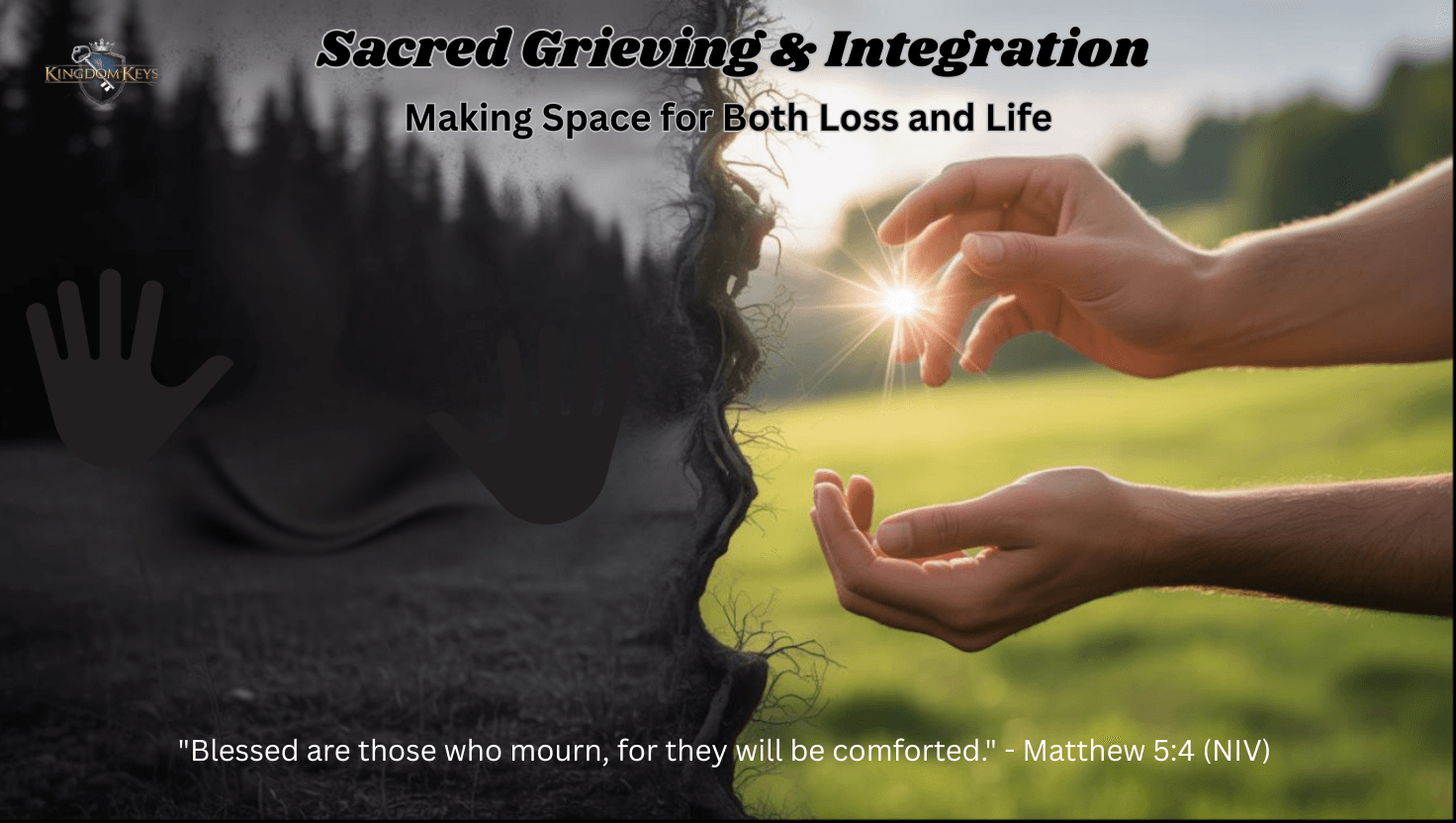
🌊 Sacred Grieving & Integration
Making Space for Both Loss and Life
Making Space for What You’ve Been Carrying
There are moments in life that quietly change everything.
Sometimes it’s the loss of a loved one…
Sometimes it’s the loss of a relationship, a dream, or a version of yourself you once knew.
Sometimes it’s not even something visible—just a deep internal shift that leaves you feeling unfamiliar within your own life.
And yet… many have been taught—directly or indirectly—that they must move past these moments quickly.
Stay strong.
Stay positive.
Keep the faith.
Don’t dwell on it.
But in trying to move forward too quickly, something important often gets left behind…
The part of you that needed space to feel.
Many seekers have learned how to pray… how to declare… how to stand in faith…
But few have been shown how to grieve in a way that is healthy, safe, and spiritually aligned.
So instead of processing grief, it gets:
Pushed down
Covered with spiritual language
Dismissed as “lack of faith”
Replaced with forced positivity
And over time, what was never allowed to be felt…
remains stored within.
It may show up as heaviness you can’t explain…
Emotional numbness…
Sudden waves of sadness…
Or a quiet sense that something within you has not fully healed.
But here is the truth this space gently invites you to receive:
You are allowed to feel what you feel.
Grief is not a sign that something is wrong with you.
It is a sign that something meaningful has been experienced, lost, or transformed.
It is not weakness.
It is not failure.
It is not a step backward.
It is part of the healing process.
Sacred grieving is not about staying stuck in pain…
It is about making space for what your heart and body are still holding—
so it can be acknowledged, processed, and eventually integrated.
You don’t have to rush this.
You don’t have to fix this.
You don’t have to hide this.
Just for this moment…
Notice what you’re feeling.
Without labeling it.
Without judging it.
If there’s heaviness… let it be there.
If there’s sadness… allow it space.
If there’s resistance… that’s okay too.
Take a slow breath…
And let your body begin to soften—just a little.
You are not alone in this.
And you do not have to carry it in silence anymore.
This is a safe place to feel.
This is more than a promise—it is an invitation.
There is a blessing connected to allowing yourself to mourn… not because grief is easy, but because it creates space for divine comfort to meet you in a real and personal way.
God does not ask you to bypass your grief in order to reach Him.
He meets you within it.
When you allow yourself to feel what has been lost, you also open yourself to receive what God is restoring
—peace, comfort, and a deeper awareness of His presence.
Grief, when held with love, becomes a doorway…
not just to healing—but to transformation.
🌊 Understanding Grief
Emotional + Spiritual + Physical
Grief is often misunderstood.
Many think of it as just an emotional reaction—something that lives in the heart or mind.
But grief is much deeper than that.
It is emotional… spiritual… and physical.
It touches every part of your being.
💧 Emotional Dimension of Grief
At the emotional level, grief is the natural response to loss.
It may show up as:
Sadness
Anger
Confusion
Regret
Emptiness
Even moments of unexpected peace
And sometimes… it doesn’t show up clearly at all.
Instead, it lingers quietly beneath the surface—
as heaviness… numbness… or emotional distance.
There is no single “correct” way to grieve.
Your experience is allowed to be:
👉 Messy
👉 Non-linear
👉 Unpredictable
One moment you may feel okay…
and the next, something small brings everything back to the surface.
This doesn’t mean you’re going backward.
It means something within you is asking to be felt.
🕊️ Spiritual Dimension of Grief
Grief is not separate from your spiritual life.
It is deeply connected to it.
In moments of loss, many people wrestle with questions like:
“Where is God in this?”
“Why did this happen?”
“Why do I still feel this way?”
But grief is not a sign of weak faith.
It is often the place where your relationship with God becomes more real…
more honest…
and more intimate.
Even Jesus, in the presence of loss, did not bypass emotion.
📖 Jesus wept. — John 11:35 (NIV)
🌿 Anchor Reflection
This simple moment carries profound truth.
Jesus, fully aware of what He was about to do…
fully connected to divine power…
still chose to feel and express grief.
He did not rush past sorrow.
He did not suppress it.
He allowed it.
This reveals something essential:
Grief and spiritual alignment can exist together.
You can be connected to God… and still feel deeply.
You can carry faith… and still mourn.
In fact, allowing yourself to feel may be part of how you remain open to God’s presence.
🌬️ Physical Dimension of Grief
Grief is not only something you feel emotionally or spiritually…
It is something your body carries.
Experiences of loss, pain, and emotional overwhelm can become stored within the body.
This is why grief may show up as:
Tightness in your chest
A lump in your throat
Fatigue or heaviness
Shallow breathing
A sense of pressure or weight you can’t explain
Even when your mind understands what has happened…
your body may still be processing it.
This is not a flaw.
It is part of how you are designed.
Your body holds what has not yet been fully released.
🌿 Bringing It All Together
Grief is not just something you “get through.”
It is something you move through… with awareness… with compassion… and with God.
Emotionally, it asks you to feel.
Spiritually, it invites you deeper.
Physically, it calls your body to release what it has been holding.
When these dimensions are honored together, something begins to shift:
👉 The pressure to “be okay” starts to lift
👉 The body begins to soften
👉 The heart begins to open
👉 God’s presence becomes easier to sense
You don’t have to figure all of this out right now.
Just begin here…
Notice what you’re feeling—emotionally…
Notice what’s happening in your body…
Notice where you may have been holding things in…
Take a slow breath…
And allow yourself to simply be present with it.
No rushing.
No fixing.
Just awareness.
Because awareness…
is often where healing begins.
⚠️ Spiritual Bypass vs Sacred Grieving
When Faith Avoids Feeling… and When It Heals
Not all “moving on” is healing.
Sometimes what looks like strength…
is actually suppression.
Sometimes what sounds like faith…
is actually avoidance.
And many seekers—without realizing it—have learned to use spiritual language as a way to move around grief instead of through it.
🚫 What Is Spiritual Bypass?
Spiritual bypass happens when we use faith, scripture, or positive thinking to avoid feeling what is real.
It can sound like:
“I’m fine… God’s got it.”
“Everything happens for a reason.”
“I just need to pray more and move on.”
“I shouldn’t feel this way if I have faith.”
These statements may carry truth…
But when they are used to shut down emotion instead of support healing,
they become a barrier.
Instead of creating freedom…
they create disconnection.
🌿 What Happens When Grief Is Bypassed?
When grief is not honored, it doesn’t disappear.
It gets stored.
It may resurface as:
Emotional numbness
Anxiety or inner tension
Irritability or unexpected emotional reactions
Feeling spiritually disconnected
A quiet heaviness that never fully lifts
The body holds what the heart was not allowed to process.
And over time, this can create a gap between:
👉 What you say you believe
👉 And what you actually feel inside
🌊 What Is Sacred Grieving?
Sacred grieving is different.
It is not about staying stuck in pain…
and it is not about abandoning faith.
It is about allowing truth and emotion to exist together.
Sacred grieving says:
👉 “This hurts… and I don’t have to pretend it doesn’t.”
👉 “I trust God… and I still need space to feel.”
👉 “I am healing… even if I don’t feel okay right now.”
It is the practice of making space for what is real—
while remaining open to God’s presence within it.
📖 The Lord is close to the brokenhearted and saves those who are crushed in spirit. — Psalm 34:18 (NIV)
🌿 Anchor Reflection
God does not distance Himself from pain—
He draws near to it.
This means you don’t have to clean yourself up emotionally before coming to Him.
You don’t have to hide your grief…
minimize it…
or rush past it to prove your faith.
Your brokenness does not repel God’s presence.
It invites it.
Sacred grieving allows you to experience this truth—not just intellectually…
but personally.
🔄 The Shift: From Avoidance to Allowing
The difference between spiritual bypass and sacred grieving is simple…
but powerful:
Bypass says: “Don’t feel this.”
Sacred grieving says: “It’s safe to feel this.”
Bypass rushes the process
Sacred grieving honors the process
Bypass avoids discomfort
Sacred grieving allows transformation
🌬️ A Gentle Moment of Awareness
Pause for a moment…
Notice your inner response:
Have there been places where you’ve tried to “stay strong”
instead of allowing yourself to feel?
Have you used spiritual language to move past something
that may still be sitting within you?
No judgment.
No pressure.
Just awareness.
Take a slow breath…
And let your body soften just a little.
You don’t have to bypass this anymore.
You are allowed to feel…
and still be deeply connected to God.
💧 The Embodied Practice
Allowing & Processing Grief
Grief does not heal through understanding alone.
It heals through allowing… feeling… and gently releasing.
This is where many seekers get stuck—not because they lack faith…
but because they were never shown how to be with what they feel in a safe and grounded way.
The goal here is not to force anything out…
not to relive pain intensely…
and not to “fix” yourself.
The invitation is simple:
To create space for your body and heart to process what they’ve been holding.
🌿 Step 1: Creating a Safe Inner Space
Before you process grief, your body needs to feel safe.
Find a quiet moment—even if it’s just a few minutes.
Sit comfortably… or place your hand gently over your heart or stomach.
Take a slow breath in through your nose…
and exhale gently through your mouth.
Again…
Slow inhale…
Soft exhale…
Let your shoulders drop.
Let your jaw relax.
You don’t have to do this perfectly.
Just begin to signal to your body that it is safe to soften.
🌊 Step 2: Noticing What Is Present
Now gently bring your awareness inward.
Without searching…
without forcing…
Just notice:
👉 What am I feeling right now?
👉 Where do I feel it in my body?
It may be:
A tightness in your chest
A heaviness in your stomach
A lump in your throat
A quiet sadness beneath the surface
Or you may feel… nothing at all.
That’s okay too.
Numbness is often a form of protected grief.
Whatever is there… let it be there.
No judgment.
No labeling.
No need to change it.
🌬️ Step 3: Allowing the Feeling
This is the most important step.
Instead of pushing the feeling away…
see if you can gently allow it.
You might say inwardly:
👉 “It’s okay for this to be here.”
👉 “I don’t have to fight this.”
👉 “I am safe to feel this.”
If emotion begins to rise… let it.
If tears come… allow them.
If nothing happens… that’s okay.
This is not about intensity—
it’s about permission.
Take a slow breath…
And imagine your breath creating space around what you feel—
not trying to remove it…
just giving it room to exist.
💧 Step 4: Staying Present Without Overwhelm
If the feeling becomes strong, gently ground yourself.
You can:
Place your feet firmly on the ground
Press your hand against your chest
Open your eyes and look around your space
Remind your body:
👉 “I am here.”
👉 “I am safe.”
👉 “This feeling is passing through me.”
You are not being consumed by the emotion.
You are witnessing and allowing it to move.
🕊️ Step 5: Inviting God Into the Moment
Grief does not have to be processed alone.
As you sit with what you feel, gently invite God’s presence into that space.
You don’t need perfect words.
Just a simple inward awareness:
“God, meet me here.”
“Be with me in this.”
“I open this space to Your presence.”
No striving.
No performance.
Just presence with Presence.
📖 He heals the brokenhearted and binds up their wounds. — Psalm 147:3 (NIV)
🌿 Anchor Reflection
Healing is not something you force—it is something God gently works within you as you allow yourself to be present.
This kind of healing doesn’t bypass your pain…
it meets you in it.
As you allow what is within you to be seen and felt, you create space for God to do what only He can do—
to bring comfort, restoration, and quiet renewal from the inside out.
🌊 Step 6: Gentle Release
As your time comes to a close, take one more slow breath.
Notice if anything has shifted—
even slightly.
Maybe the feeling softened…
Maybe it moved…
Maybe you simply became more aware.
That is enough.
You don’t need to “complete” the process in one moment.
Grief is not released all at once—
it is released in layers.
Gently thank your body for allowing you to feel.
And remind yourself:
👉 “I can return to this when I’m ready.”
👉 “I don’t have to rush my healing.”
🌿 Closing the Practice
Place your hand over your heart…
Take a final breath…
And allow yourself to simply rest in this moment.
You showed up.
You allowed.
You made space.
That is sacred work.
💧 The Embodied Practice
Allowing & Processing Grief
Grief does not heal through understanding alone.
It heals through allowing… feeling… and gently releasing.
This is where many seekers get stuck—not because they lack faith…
but because they were never shown how to be with what they feel in a safe and grounded way.
The goal here is not to force anything out…
not to relive pain intensely…
and not to “fix” yourself.
The invitation is simple:
To create space for your body and heart to process what they’ve been holding.
🌿 Step 1: Creating a Safe Inner Space
Before you process grief, your body needs to feel safe.
Find a quiet moment—even if it’s just a few minutes.
Sit comfortably… or place your hand gently over your heart or stomach.
Take a slow breath in through your nose…
and exhale gently through your mouth.
Again…
Slow inhale…
Soft exhale…
Let your shoulders drop.
Let your jaw relax.
You don’t have to do this perfectly.
Just begin to signal to your body that it is safe to soften.
🌊 Step 2: Noticing What Is Present
Now gently bring your awareness inward.
Without searching…
without forcing…
Just notice:
👉 What am I feeling right now?
👉 Where do I feel it in my body?
It may be:
A tightness in your chest
A heaviness in your stomach
A lump in your throat
A quiet sadness beneath the surface
Or you may feel… nothing at all.
That’s okay too.
Numbness is often a form of protected grief.
Whatever is there… let it be there.
No judgment.
No labeling.
No need to change it.
🌬️ Step 3: Allowing the Feeling
This is the most important step.
Instead of pushing the feeling away…
see if you can gently allow it.
You might say inwardly:
👉 “It’s okay for this to be here.”
👉 “I don’t have to fight this.”
👉 “I am safe to feel this.”
If emotion begins to rise… let it.
If tears come… allow them.
If nothing happens… that’s okay.
This is not about intensity—
it’s about permission.
Take a slow breath…
And imagine your breath creating space around what you feel—
not trying to remove it…
just giving it room to exist.
💧 Step 4: Staying Present Without Overwhelm
If the feeling becomes strong, gently ground yourself.
You can:
Place your feet firmly on the ground
Press your hand against your chest
Open your eyes and look around your space
Remind your body:
👉 “I am here.”
👉 “I am safe.”
👉 “This feeling is passing through me.”
You are not being consumed by the emotion.
You are witnessing and allowing it to move.
🕊️ Step 5: Inviting God Into the Moment
Grief does not have to be processed alone.
As you sit with what you feel, gently invite God’s presence into that space.
You don’t need perfect words.
Just a simple inward awareness:
“God, meet me here.”
“Be with me in this.”
“I open this space to Your presence.”
No striving.
No performance.
Just presence with Presence.
📖 A Living Example — Jesus at Lazarus’ Tomb
There is a moment in scripture that reflects this practice more clearly than words alone ever could.
When Jesus arrived at the tomb of Lazarus, He already knew what was about to happen.
He knew restoration was coming.
He knew death would not have the final word.
And yet…
He did not rush past the moment.
He stood in the presence of grief.
He saw the pain of those around Him.
He felt the weight of loss.
And He allowed Himself to be moved by it.
📖 Jesus wept. — John 11:35 (NIV)
🌿 Anchor Reflection
This moment reveals something deeply important:
Jesus did not bypass grief—even when He carried the power to change the outcome.
He allowed Himself to feel.
He allowed sorrow to be present.
He allowed emotion to move through Him.
This shows us that grief is not a lack of faith.
It is not a sign of disconnection from God.
It is part of what it means to be fully present…
fully human…
and fully open.
In your own moments of grief, you are not stepping away from God by feeling.
You are stepping into a space where He is already present.
📖 He heals the brokenhearted and binds up their wounds. — Psalm 147:3 (NIV)
Healing is not something you force—it is something God gently works within you as you allow yourself to be present.
This kind of healing doesn’t bypass your pain…
it meets you in it.
As you allow what is within you to be seen and felt, you create space for God to do what only He can do—
to bring comfort, restoration, and quiet renewal from the inside out.
🌊 Step 6: Gentle Release
As your time comes to a close, take one more slow breath.
Notice if anything has shifted—
even slightly.
Maybe the feeling softened…
Maybe it moved…
Maybe you simply became more aware.
That is enough.
You don’t need to “complete” the process in one moment.
Grief is not released all at once—
it is released in layers.
Gently thank your body for allowing you to feel.
And remind yourself:
👉 “I can return to this when I’m ready.”
👉 “I don’t have to rush my healing.”
🌿 Closing the Practice
Place your hand over your heart…
Take a final breath…
And allow yourself to simply rest in this moment.
You showed up.
You allowed.
You made space.
That is sacred work.
📖 Biblical Anchor
Comfort, Mourning, and God’s Presence
Grief is not unfamiliar territory in scripture.
From beginning to end, we see a consistent truth:
God does not distance Himself from sorrow—He draws near to it.
He does not require you to hide your pain in order to experience His presence.
He meets you within it.
📖 Blessed are those who mourn, for they will be comforted. — Matthew 5:4 (NIV)
🌿 Anchor Reflection
This is not just a future promise—it is a present invitation.
There is something sacred about mourning…
because it creates an opening for divine comfort to enter.
God does not ask you to rush past grief to receive Him.
He meets you in the very place where your heart feels most tender.
Your mourning is not a barrier to His presence.
It is often the doorway.
📖 The Lord is close to the brokenhearted and saves those who are crushed in spirit. — Psalm 34:18 (NIV)
🌿 Anchor Reflection
There is no distance between God and your pain.
When your heart feels heavy…
when your spirit feels low…
when words are hard to find…
He is near.
Not waiting for you to feel better.
Not requiring you to “get it together.”
But present…
steady…
and gently holding space for you to heal.
📖 A time to weep and a time to laugh, a time to mourn and a time to dance. — Ecclesiastes 3:4 (NIV)
🌿 Anchor Reflection
Grief is not a disruption to life’s rhythm—it is part of it.
There is a time to weep.
A time to mourn.
And eventually… a time to rise again.
You are not meant to stay in sorrow forever…
but you are also not meant to skip over it.
Each season has purpose.
And honoring the season of grief allows the next season—
renewal, peace, and joy—
to emerge naturally.
🌊 Bringing It All Together
Scripture does not rush you through grief.
It does not shame you for feeling.
It does not demand emotional perfection.
Instead, it reveals a pattern:
👉 Mourning is acknowledged
👉 God’s presence is near
👉 Comfort is promised
👉 Renewal follows in time
You are not outside of God’s will because you are grieving.
You are in a sacred process that He fully understands…
and faithfully walks with you through.
🌬️ A Gentle Moment of Receiving
Take a slow breath…
Let these truths settle—not just in your mind… but in your body.
You don’t have to strive for comfort.
You don’t have to force peace.
Simply allow yourself to receive this:
👉 God is near to you… right now
👉 Your grief is seen… not ignored
👉 Comfort is not distant… it is available
Let your body soften… just a little.
You are not alone in this.
🔄 Integration Practice
Moving Through Grief Without Getting Stuck
Grief is not meant to be avoided…
but it is also not meant to become a place you remain in indefinitely.
There is a natural movement within grief:
👉 From feeling…
👉 To processing…
👉 To integrating…
👉 To renewing
But this movement doesn’t happen through force.
It happens through gentle awareness… consistent presence… and small, intentional steps forward.
🌿 What Integration Really Means
Integration is not “getting over” what happened.
It is learning how to:
✔ Carry the memory without being consumed by it
✔ Honor what was lost without losing yourself
✔ Allow the experience to shape you… without defining you
You don’t leave grief behind.
You learn how to move forward with it—transformed, softened, and more aware.
⚖️ The Balance: Feeling Without Getting Stuck
There is a sacred balance in this process:
Avoiding grief keeps it stored
Living only in grief keeps you stuck
Integration happens in the middle:
👉 You allow yourself to feel
👉 And you gently return to life
Not all at once…
but in small, meaningful ways.
🌊 Practice 1: The “Feel and Return” Rhythm
This simple rhythm helps your body process grief safely without overwhelm.
When grief arises:
Pause and Feel
Notice what’s present
Allow the emotion spaceBreathe and Soften
Let your body relax around the feelingReturn Gently to the Present
Look around your space
Reconnect with your surroundings
This teaches your body:
👉 “I can feel this… and I am still safe.”
👉 “This emotion can move through me.”
Over time, this creates emotional resilience without suppression.
🌬️ Practice 2: Creating Small Moments of Life Again
Grief can make the world feel heavy… distant… or muted.
Integration includes gently re-engaging with life—without guilt.
This may look like:
Stepping outside for fresh air
Listening to music that soothes you
Smiling or laughing—and allowing it
Connecting with someone you trust
These moments do not dishonor your grief.
They create space alongside it.
You are allowed to feel sadness…
and still experience moments of light.
🕊️ Practice 3: Letting Meaning Emerge Naturally
You don’t have to force meaning out of your pain.
But over time… something begins to shift.
As you process and integrate, you may notice:
👉 A deeper compassion for others
👉 A clearer sense of what truly matters
👉 A softer, more open heart
👉 A stronger connection to God
This is not about justifying loss.
It is about recognizing that transformation can emerge from what you’ve walked through.
📖 and provide for those who grieve in Zion—to bestow on them a crown of beauty instead of ashes, the oil of joy instead of mourning, and a garment of praise instead of a spirit of despair. — Isaiah 61:3 (NIV)
🌿 Anchor Reflection
This is the movement of integration.
Not instant replacement…
not forced positivity…
But a gentle transformation over time.
What once felt like ashes does not disappear overnight—
but as you allow yourself to move through grief with God,
something new begins to take shape.
Peace begins to settle.
Strength begins to return.
And slowly… what felt heavy becomes something you can carry differently.
🌊 A Gentle Check-In
Pause for a moment…
Where are you right now in your process?
Are you:
👉 Avoiding what needs to be felt?
👉 Sitting deeply in grief?
👉 Beginning to feel small shifts forward?
There is no right or wrong place.
Only the invitation to stay present with where you are.
🌿 Moving Forward Gently
You don’t have to rush into the next season.
But you also don’t have to stay where you are forever.
Take one small step today:
✔ Feel what is present
✔ Allow your body to soften
✔ Reconnect with life in a small way
That is enough.
Grief, when honored…
becomes integrated.
And when integrated…
it no longer holds you in place—
it becomes part of your transformation.
🕊️ Guided Prayer / Sacred Release Moment
Releasing What You’ve Been Carrying Into God’s Presence
Find a quiet moment…
If you’re able, gently close your eyes…
or soften your gaze.
Place your hand over your heart…
or wherever you feel tension or heaviness in your body.
Take a slow breath in…
And exhale gently…
Again…
Slow inhale…
Soft exhale…
Let your body begin to settle.
🌿 Entering the Moment
You don’t need perfect words.
You don’t need to perform.
You don’t need to hide anything you’re feeling.
Just come as you are.
🙏 Guided Prayer
God…
You see what I’ve been carrying—
even the parts I haven’t had words for.
You see the loss…
the disappointment…
the pain that still feels present within me.
And right now…
I choose not to push it away.
I choose not to hide it.
I bring it to You.
( Pause here for a moment… )
If there is a specific loss or feeling that comes to mind…
gently allow it to surface.
No forcing…
just noticing.
God…
This is what I’ve been holding…
( Allow space here to silently name it… )
I release the need to carry this alone.
I release the pressure to be “okay” before I’m ready.
I release the weight I’ve been holding in my body…
and I place it into Your hands.
( Take a slow breath… )
Meet me here, God.
In this exact place.
Not after I’ve healed…
not after I’ve figured it out…
but right here… as I am.
Let Your presence fill the space where this pain has been.
Let Your peace settle into my body.
Let Your comfort reach the places within me that still feel tender.
( Pause… breathe… )
I give myself permission to feel…
and I trust that I am not alone in it.
I trust that You are with me…
holding me…
restoring me…
gently… and in Your timing.
🌬️ Receiving
Take a slow breath in…
And as you exhale…
Imagine releasing just a small portion of what you’ve been holding.
Not all of it…
Just what you’re ready to release right now.
Feel your body…
Notice any shift—even if it’s subtle.
A softening…
A little more space…
A quiet sense of calm…
🌿 Closing the Moment
You don’t have to rush out of this space.
Just rest here for a moment.
Let yourself be held.
Let yourself be seen.
Let yourself receive.
When you’re ready…
Take one more slow breath…
And gently bring your awareness back to the present.
You don’t have to carry this alone anymore.
What you released…
God received.
And what remains…
He will walk with you through.
✍️ Reflection & Processing Prompts
Creating Space to Acknowledge, Feel, and Integrate
Take a quiet moment…
You don’t need to answer everything at once.
You don’t need perfect words.
This is simply an invitation to be honest with yourself—
gently… and without judgment.
If possible, write your responses down.
If not, just sit with the questions and notice what arises.
🌿 Becoming Aware of Your Grief
What loss, change, or experience in my life still feels unresolved within me?
Is there something I’ve been telling myself I should be “over by now”?
What emotions tend to surface when I slow down or become quiet?
Do I notice sadness, anger, numbness, confusion… or something else?
🌊 Recognizing Patterns of Avoidance
Have I been avoiding certain feelings by staying busy, distracted, or “positive”?
Have I used spiritual language or faith to move past something I haven’t fully processed?
Are there moments where I feel disconnected from myself emotionally?
What might I be afraid would happen if I fully allowed myself to feel?
💧 Connecting With the Body
Where do I feel heaviness, tension, or discomfort in my body?
What does that sensation feel like (tight, heavy, numb, pressured, etc.)?
What happens when I bring gentle awareness to that area?
Can I allow that sensation to be there… without trying to change it?
🕊️ Inviting God Into the Process
What would it look like for me to let God meet me in this area of grief?
Is there anything I’ve been holding back from God emotionally?
Can I allow myself to be fully seen—without filtering or hiding?
What does God’s presence feel like to me in moments of stillness?
🔄 Moving Toward Integration
What is one small step I can take to gently honor what I’ve been feeling?
Where do I sense a need for more compassion toward myself?
Am I allowing moments of light, peace, or connection alongside my grief?
What might it look like to move forward… without rushing the process?
🌬️ A Gentle Closing Reflection
Take a slow breath…
As you reflect, remember:
👉 You don’t have to solve everything today
👉 You don’t have to fully understand everything right now
👉 Awareness itself is part of healing
Whatever came up for you…
Honor it.
You showed up.
You allowed yourself to look within.
That is meaningful.
That is progress.
That is sacred work.
🧰 Tools for the Journey
Support for Walking Through Grief with Awareness and Grace
Grief is not something you process once and move on from.
It unfolds in layers… over time… in moments you don’t always expect.
Having simple, supportive tools can help you navigate those moments without becoming overwhelmed… or shutting down.
These are not meant to be used perfectly.
They are here to support you—gently and consistently—as you continue your healing journey.
🌬️ 1. Breath Awareness for Emotional Release
When grief rises, the body often tightens.
Breath is one of the simplest ways to begin softening that response.
Practice:
Inhale slowly through your nose for 4 seconds
Hold gently for 2 seconds
Exhale slowly through your mouth for 6 seconds
Repeat for a few cycles.
As you breathe, bring awareness to where you feel tension or heaviness.
You’re not trying to remove the feeling—
just creating space around it.
💧 2. The “Name It to Release It” Practice
Unprocessed grief often stays stuck because it remains unnamed.
Gently putting words to what you feel can begin to release its hold.
Practice:
Pause and say inwardly:
👉 “This is sadness.”
👉 “This is grief.”
👉 “This is disappointment.”
No analysis.
No judgment.
Just acknowledgment.
Naming the feeling helps your nervous system recognize:
👉 “I am aware of this… and I am safe.”
🌊 3. Body Check-In (Daily Awareness Practice)
Your body often holds what your mind has moved past.
This simple check-in helps you stay connected to what is still being processed.
Practice:
Once a day, pause and ask:
👉 “What am I feeling right now?”
👉 “Where do I feel it in my body?”
Sit with it for a few moments.
Breathe into that space.
Let it be there—without trying to fix it.
✍️ 4. Grief Journaling (Emotional Expression Tool)
Sometimes what we cannot say out loud needs a place to be expressed.
Journaling creates a safe container for that.
Practice:
Write freely without editing yourself.
You can begin with:
“What I miss is…”
“What I wish I could say is…”
“What I’m still feeling is…”
Let it flow.
No structure.
No perfection.
Just honesty.
🕊️ 5. Sacred Pause with God
You don’t always need a long prayer.
Sometimes a simple moment of presence is enough.
Practice:
Pause… close your eyes…
And inwardly say:
👉 “God, I’m here.”
👉 “Meet me in this.”
Then sit in stillness for a few moments.
Let yourself be present…
and allow His presence to meet you there.
🌿 6. Allowing Moments of Light
Grief can make it feel wrong to experience joy or peace.
But healing includes allowing both.
Practice:
When a moment of light comes—a smile, laughter, peace—
👉 Don’t push it away
👉 Don’t feel guilty for it
Simply allow it.
Light and grief can coexist.
🌊 7. The “Return to Safety” Grounding Tool
If emotions feel overwhelming, grounding helps bring your body back to stability.
Practice:
Look around and name:
5 things you can see
4 things you can touch
3 things you can hear
2 things you can feel in your body
1 thing you can take a deep breath into
This gently brings your awareness back to the present moment.
📖 God’s love remains constant, and His compassion does not run out.
Each new day carries fresh mercy and renewed grace. — Lamentations 3:22–23 (NIV)
🌿 Anchor Reflection
Even in the midst of grief… you are not without support.
There may be moments where the weight feels heavy…
where the emotions return unexpectedly…
where it seems like healing is slower than you hoped.
But this truth remains steady:
You are not being consumed by what you feel.
God’s compassion does not wear thin with you.
His patience does not run out.
His presence does not withdraw when grief resurfaces.
Each day—no matter how it feels—
there is new mercy available to meet you where you are.
Not because everything is resolved…
but because you are being sustained through the process.
These tools are not about rushing your healing.
They are here to support you as you:
✔ Feel safely
✔ Process honestly
✔ Stay connected to God
✔ Move forward gently
Return to them as needed.
There is no pressure to use them all at once.
Just take what supports you in the moment…
and allow your healing to unfold—
one layer at a time.
✍️ Reflection & Processing Prompts
Creating Space to Acknowledge, Feel, and Integrate
Take a quiet moment…
You don’t need to answer everything at once.
You don’t need perfect words.
This is simply an invitation to be honest with yourself—
gently… and without judgment.
If possible, write your responses down.
If not, just sit with the questions and notice what arises.
🌿 Becoming Aware of Your Grief
What loss, change, or experience in my life still feels unresolved within me?
Is there something I’ve been telling myself I should be “over by now”?
What emotions tend to surface when I slow down or become quiet?
Do I notice sadness, anger, numbness, confusion… or something else?
🌊 Recognizing Patterns of Avoidance
Have I been avoiding certain feelings by staying busy, distracted, or “positive”?
Have I used spiritual language or faith to move past something I haven’t fully processed?
Are there moments where I feel disconnected from myself emotionally?
What might I be afraid would happen if I fully allowed myself to feel?
💧 Connecting With the Body
Where do I feel heaviness, tension, or discomfort in my body?
What does that sensation feel like (tight, heavy, numb, pressured, etc.)?
What happens when I bring gentle awareness to that area?
Can I allow that sensation to be there… without trying to change it?
🕊️ Inviting God Into the Process
What would it look like for me to let God meet me in this area of grief?
Is there anything I’ve been holding back from God emotionally?
Can I allow myself to be fully seen—without filtering or hiding?
What does God’s presence feel like to me in moments of stillness?
🔄 Moving Toward Integration
What is one small step I can take to gently honor what I’ve been feeling?
Where do I sense a need for more compassion toward myself?
Am I allowing moments of light, peace, or connection alongside my grief?
What might it look like to move forward… without rushing the process?
🌬️ A Gentle Closing Reflection
Take a slow breath…
As you reflect, remember:
👉 You don’t have to solve everything today
👉 You don’t have to fully understand everything right now
👉 Awareness itself is part of healing
Whatever came up for you…
Honor it.
You showed up.
You allowed yourself to look within.
That is meaningful.
That is progress.
That is sacred work.
💬 Closing Encouragement + Final Declaration
From Mourning to Renewal—Held, Not Rushed
Grief is not a detour on your journey.
It is part of the path.
And the fact that you’ve allowed yourself to slow down…
to feel…
to become aware…
to invite God into this space…
means something is already shifting within you.
You may not have all the answers.
You may not feel completely “better.”
You may still have moments where the weight returns.
That’s okay.
Healing does not happen all at once.
It unfolds…
👉 In layers
👉 In moments
👉 In quiet shifts you may not always notice right away
But every time you choose to feel instead of suppress…
Every time you choose to allow instead of avoid…
Every time you choose to stay present instead of disconnect…
You are moving forward.
🌿 A Truth to Carry With You
You are not behind in your healing.
You are not doing this wrong.
You are not meant to rush what your heart and body are still processing.
You are exactly where you need to be in this moment.
And God is not waiting for you on the other side of your grief…
He is walking with you through it.
🌊 From Mourning to Renewal
There will come a time…
Not forced.
Not rushed.
But naturally…
Where the weight begins to feel lighter.
Where the memories feel different.
Where your heart feels more open again.
Not because you forgot…
But because you integrated.
What once felt overwhelming…
becomes something you can carry with peace.
What once felt like an ending…
becomes part of your transformation.
🕊️ Final Declaration
Take a slow breath…
Let these words settle—not just in your mind… but in your body.
Repeat them quietly… or simply receive them:
I give myself permission to grieve without rushing the process.
I honor what I have experienced, and I allow myself to feel without judgment.
I am not alone in my healing—God is with me in every moment.
I release the need to suppress what is real, and I open myself to gentle restoration.
I trust that healing is unfolding within me, even when I cannot see it.
I am moving, in my own time, from mourning… to peace… to renewal.
🌬️ A Final Moment
Take one more slow breath…
Let your body soften…
Let your heart settle…
And carry this with you:
You are held.
You are seen.
And you are gently being restored.
📬 Continue Your Journey in Truth
Stay Connected. Go Deeper. Walk This Out.
If this page spoke to your heart…
if something within you softened, shifted, or became clearer…
That’s not by accident.
It’s an invitation.
An invitation to continue the journey—not just in understanding…
but in embodiment… healing… and transformation.
You don’t have to walk this path alone.
Stay Connected & Keep Growing
Receive ongoing encouragement, teachings, and practical tools designed to help you:
✔ Process and integrate what you’re learning
✔ Stay grounded in truth during life’s challenges
✔ Grow in awareness, healing, and spiritual alignment
📩 Sign up below for the Kingdom Keys newsletter
🌊 Explore Deeper Resources
If you’re ready to go deeper, explore resources designed to support your healing journey:
📘 Transformational Teachings & eBooks
Go deeper into topics like inner healing, identity, and spiritual alignment.
🎧 Guided Practices & Meditations
Experience audio-based tools to help you regulate, release, and reconnect.
🎓 Kingdom Keys Academy (Coming Soon)
Step into structured, life-changing courses designed for true transformation—not just information.
📩 Sign Up For the Kingdom Chronicle Newsletter
Step into a growing space of truth, alignment, and transformation.
(Submit your email address below)
🎓 Go Deeper with Guided Support
When you're ready to explore deeper:
The Kingdom Keys Academy of Divine Transformation offers structured teachings,
guided practices, and immersive experiences designed to help you:
✔ Strengthen discernment
✔ Rebuild identity and inner confidence
✔ Practice alignment in daily life
✔ Embody truth in a real and lasting way
💬 Engage with the Community
Connect with others walking a similar path…
Share insights, ask questions, and grow together in a space centered on truth and transformation.
🌿 A Final Invitation
There is no pressure here.
No rush to become anything.
Just an open invitation…
to continue returning…
to continue practicing…
to continue becoming aligned with what is true.
And when you’re ready…
Your next step will meet you.



Support Kingdom Keys
Help Us Continue Providing Life-Changing Resources
If this page has spoken to your heart…
If you’ve found clarity, encouragement, or a deeper sense of truth…
And if you believe in the mission of Kingdom Keys—
to provide transformational resources that help individuals
heal, grow, and realign with their true identity—
We invite you to consider supporting this work.
Your Support Makes a Difference
Every contribution—big or small—helps us:
✨ Create more teachings like this one
✨ Provide free resources to those who need them most
✨ Develop deeper tools, courses, and guided experiences
✨ Expand the reach of Kingdom Keys to impact more lives
🕊️ A Shared Mission
Kingdom Keys exists to:
✔ Help individuals return to truth
✔ Bridge understanding from tradition into transformation
✔ Offer real tools for healing, growth, and alignment
Your support helps make that possible.
✨ Ways to Support
You can support Kingdom Keys in a way that feels right for you:
💝 One-time contribution
💝 Ongoing monthly support
💝 Sharing this page with someone who may need it

May every key unlock new levels of faith, wisdom, and divine alignment within you.
“Thank you for being part of the Kingdom Keys family.”
© 2025 Kingdom Keys. All Rights Reserved.