
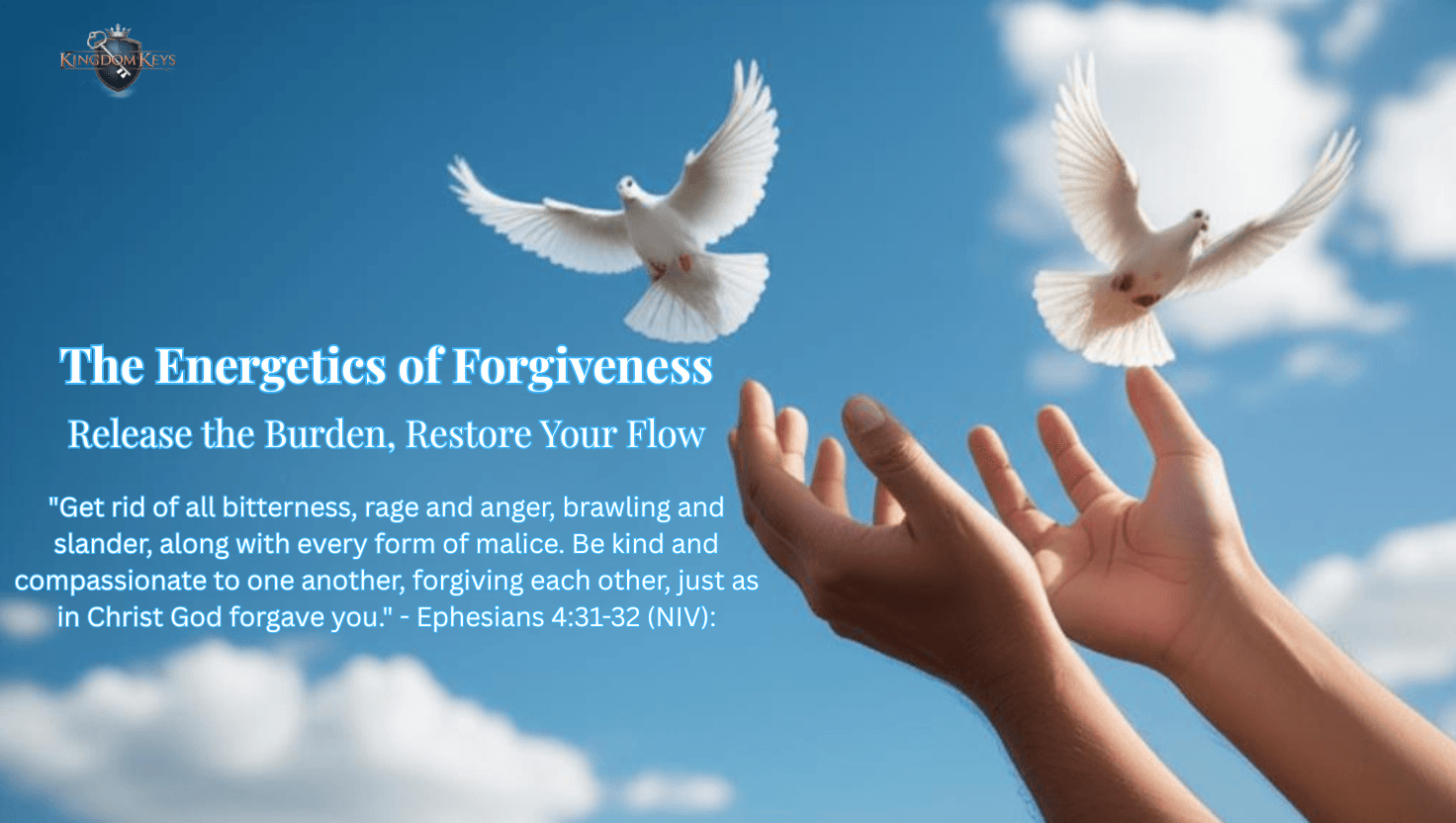
💓 The Energetics of Forgiveness
Release the Burden, Restore Your Flow
The Weight of Holding On
There are moments in life that leave a mark…
Words that cut deeper than expected.
Betrayals that shift how you see people.
Disappointments that linger longer than you thought they would.
And even when time passes… something inside you still holds it.
Not always loudly—
but quietly… persistently.
It shows up in the replaying of conversations.
The tightening in your chest when you remember.
The subtle resistance when trust is required again.
The heaviness that lingers without explanation.
You may have tried to move on.
Tried to “let it go.”
Tried to be strong… or spiritual… or unaffected.
But the truth is—
when pain isn’t released, it doesn’t disappear… it settles.
It settles into the body as tension.
Into the mind as looping thoughts.
Into the heart as guardedness.
Into the spirit as a quiet disconnection from peace.
And over time, what was once a moment…
becomes a weight you carry.
Not because you want to…
but because no one showed you how to safely put it down.
So instead, you’ve held it.
You’ve carried the memory.
The emotion.
The unresolved energy of what happened.
And maybe part of you feels justified in holding on…
because what happened mattered.
It hurt.
It shouldn’t have happened.
And you’re right.
This isn’t about denying that.
This isn’t about pretending it didn’t affect you.
This isn’t about forcing yourself to forgive before you’re ready.
This is about gently recognizing something deeper:
Holding onto the pain is also holding onto its weight.
And that weight…
is costing you more than you realize.
It can drain your energy.
Cloud your clarity.
Tighten your body.
Limit your ability to feel fully open, safe, and at peace.
Not because you’re weak—
but because you’re human.
So before anything else… take a moment.
Notice your body.
Where do you feel tightness when you think about what happened?
Is it in your chest… your shoulders… your stomach?
Notice your thoughts.
Do they loop… replay… try to make sense of it all?
Notice your heart.
Is there resistance… heaviness… or a quiet ache that hasn’t fully released?
Just notice.
No pressure.
No judgment.
No expectation to fix it right now.
Simply become aware of what you’ve been carrying.
And as you do… hear this gently:
You don’t have to carry this forever.
There is a way to release the weight—
not by denying your pain…
but by freeing yourself from its hold.
And you won’t be forced into that process.
You’ll be guided…
safely… gently… and truthfully.
Because forgiveness, at its core,
is not about what they did—
It’s about what you no longer have to carry.
This invitation is not a command to suppress your pain—it’s a call to release what is weighing you down.
Bitterness, anger, and resentment are not just emotional states… they are burdens the body and spirit
were never meant to carry long-term.
Forgiveness, in this light, becomes less about obligation and more about freedom
—an opening back into compassion, peace, and alignment with God.
🌊 Understanding Forgiveness
Energetic & Spiritual Release
Forgiveness has often been taught as a decision…
a moral responsibility…
or something you “should” do to be right with God.
But when forgiveness is approached that way, it can feel forced.
Premature.
Even unsafe.
Because deep down, something in you knows:
You can’t genuinely release something
that you haven’t first acknowledged… felt… and understood.
So let’s shift the lens.
Forgiveness is not first a behavior—
it is a release of energy.
It is what happens when the emotional charge
attached to a painful experience
is no longer held in your body, your thoughts, or your spirit.
When something hurt you,
it didn’t just affect your memory—
It created an internal imprint.
An energetic loop.
A charge that lives in:
✔ Your nervous system (tension, alertness, contraction)
✔ Your mind (replaying, analyzing, justifying)
✔ Your emotions (anger, sadness, resentment)
✔ Your spirit (disconnection, heaviness, guardedness)
And as long as that charge remains active…
you remain connected to the experience.
Not physically—
but internally.
This is why you can be far removed from a situation…
yet still feel it as if it just happened.
Because the body and spirit are still holding it.
Forgiveness, then, is not saying:
“That didn’t matter.”
Forgiveness is saying:
“I am ready to release what this has been doing inside of me.”
It is the moment you begin to:
➡️ Loosen the grip of the memory
➡️ Release the emotional charge
➡️ Allow your body to soften
➡️ Let your spirit return to peace
It’s not about the past changing—
it’s about your relationship to the past being transformed.
And here’s what’s important to understand:
You can forgive…
and still acknowledge that what happened was wrong.
You can forgive…
and still maintain clear, healthy boundaries.
You can forgive…
without restoring access to people who caused harm.
Because forgiveness is not reconciliation.
It is not trust.
It is not permission.
It is freedom.
Freedom from carrying what your system was never designed to hold long-term.
Take a moment here.
Notice what happens in your body
when you think about releasing the need to hold onto the pain.
Do you feel resistance?
Tightness?
A sense of “If I let this go… what does that mean?”
That’s okay.
That doesn’t mean you’re doing it wrong—
it means you’re becoming aware.
And awareness is the first step toward true release.
So gently remind yourself:
You are not being asked to excuse anything.
You are not being asked to forget.
You are not being asked to abandon your boundaries.
You are being invited…
to come out of internal entanglement
and back into flow.
Because when the emotional charge is released…
Your nervous system begins to settle.
Your thoughts become clearer.
Your body softens.
Your spirit opens again to God’s presence.
And what once felt heavy…
no longer has the same hold on you.
This is the deeper truth:
Forgiveness is not something you force—
it is something you allow…
as your system becomes safe enough
to let go.
This verse acknowledges that real grievances exist—real pain, real offense, real emotional impact.
Forgiveness is not the denial of that reality… it is the decision to no longer carry it in a way that keeps you bound.
As you release the internal hold of the grievance, you create space for peace, healing, and restored flow with God.
⚠️ Signs of Unforgiveness in the Body & Spirit
Unforgiveness doesn’t always announce itself clearly.
It doesn’t always sound like:
“I refuse to forgive.”
More often… it shows up subtly.
Quietly.
Through patterns you may not immediately connect to the original pain.
Because when something hasn’t been released internally,
it continues to express itself—
through your body, your thoughts, your emotions, and your spiritual state.
Not as punishment…
but as a signal.
A signal that something within you
is still holding.
Take a moment here—not to judge yourself…
but to gently observe.
🧠 In the Mind
Unforgiveness often appears as mental looping.
Replaying what happened…
Rewriting conversations…
Trying to make sense of it over and over again.
You may notice:
✔ Rehearsing what you wish you had said
✔ Mentally defending yourself long after the moment has passed
✔ Difficulty letting the situation feel “finished”
✔ Thoughts that return even when you try to move forward
This isn’t because you’re stuck—
it’s because the experience is still active within you.
💓 In the Body
Your body holds what hasn’t been released.
Even when your mind says,
“I’m over it,”
your body may still be carrying the charge.
Notice if you experience:
✔ Tightness in your chest or throat
✔ Tension in your shoulders or jaw
✔ A heavy or uneasy feeling in your stomach
✔ Fatigue that doesn’t seem to have a clear cause
These are not random sensations.
They are your body’s way of saying:
“There’s something here that hasn’t been fully processed or released.”
💧 In Your Emotions
Unforgiveness often lingers as emotional residue.
Not always intense—
but persistent.
You may notice:
✔ Irritability or shortness when the topic arises
✔ Emotional numbness or disconnection
✔ Sudden waves of sadness or anger
✔ A quiet bitterness that feels difficult to name
Sometimes, the emotion isn’t even about the present moment—
it’s the past… still echoing.
🌿 In Your Spirit
Unforgiveness can subtly affect your spiritual connection.
Not by separating you from God—
but by creating internal noise that makes it harder to feel peace, clarity, and openness.
You may notice:
✔ Feeling spiritually distant or disconnected
✔ Difficulty settling into prayer or stillness
✔ A sense of heaviness during moments that used to feel light
✔ Resistance when thinking about releasing the situation
Again—this is not failure.
This is awareness.
🕊️ Gentle Awareness Invitation
Pause for a moment.
Take a slow breath.
And ask yourself—without pressure:
👉 Where do I feel this in my body?
👉 What thoughts keep returning?
👉 What emotions still feel unresolved?
Just notice.
No need to fix it yet.
No need to rush forgiveness.
Awareness is not weakness—
it is the beginning of release.
Because what you can gently see…
you can eventually release.
And what you release…
no longer has to live within you.
💧 The Embodied Practice
Releasing the Emotional Charge
Forgiveness is not something you think your way into…
it’s something you allow your body and spirit to move through.
This is where many get stuck.
They understand forgiveness mentally—
but the emotional charge is still present.
The tension is still there.
The memory still feels activated.
The body still responds.
That’s because true forgiveness is not just a decision—
it’s a release process.
And that process happens through awareness, safety, and gentle surrender.
Not force.
Not pressure.
Not pretending.
So here, we shift from understanding…
into embodiment.
🌿 Step 1: Acknowledge What You’re Holding
Before anything can be released,
it must be honestly acknowledged.
Not minimized.
Not spiritualized away.
Not rushed past.
Gently bring the situation to mind.
Not to relive it—
but to recognize what is still active within you.
And ask yourself:
👉 What am I still carrying from this?
👉 What emotion feels strongest right now?
👉 Where do I feel this in my body?
Let yourself be honest.
It’s safe to acknowledge what hurt.
🌬️ Step 2: Create Safety in Your Body
Your body will not release what it does not feel safe enough to let go of.
So before asking it to release—
invite it into calm.
Take a slow breath in through your nose…
and gently exhale through your mouth.
Again.
Let your shoulders drop.
Unclench your jaw.
Soften your chest.
You don’t have to force anything.
Just begin to signal to your body:
“It’s safe to soften…
It’s safe to release…
I don’t have to stay braced.”
Stay here for a few breaths.
💧 Step 3: Feel Without Holding
Now, gently allow yourself to feel what is present—
without gripping it…
and without pushing it away.
If emotion rises—
let it move.
If there’s sadness… let it soften through you.
If there’s anger… let it be acknowledged without acting on it.
If there’s heaviness… just notice it.
You are not becoming the emotion.
You are allowing it to pass through your system.
This is where the charge begins to loosen.
🕊️ Step 4: Release the Internal Grip
When you’re ready—not forced, but willing—
gently shift your intention.
Not toward the person…
but toward your own freedom.
Quietly say within yourself:
“I am ready to release what this has been doing inside of me.”
Not all at once.
Not perfectly.
Just a willingness.
And as you breathe…
imagine the emotional weight loosening.
Like something untying within you.
Like pressure slowly lifting.
You don’t have to push it out.
Just allow it to leave gently.
🌊 Step 5: Return to Peace
As the intensity softens—
even slightly—
notice what begins to open.
Your breath may feel easier.
Your body may feel lighter.
Your thoughts may quiet.
Stay with that.
Let your system recognize:
“This is what release feels like.”
You may not feel complete freedom yet—
and that’s okay.
Forgiveness can be a process.
But every moment of release…
restores a piece of your flow.
🌿 Gentle Reminder
You are not excusing what happened.
You are not saying it was okay.
You are not removing boundaries.
You are simply choosing:
“I no longer want to carry this in my body,
my mind, and my spirit.”
And that choice…
is where true healing begins.
🕊️ Pause Here
Take one more slow breath.
Notice your body.
Notice any shift—no matter how small.
And remember:
You don’t have to do this all at once.
You are learning how to release safely…
and return to yourself
one layer at a time.
📖 Biblical Anchor + Story Integration
From Betrayal to Release
Forgiveness is not just a concept—
it is a lived path… one that has been walked before.
And one of the most powerful demonstrations of this journey
is found in the life of Joseph.
Joseph didn’t experience a small offense.
He was betrayed by his own brothers.
Rejected.
Sold into slavery.
Separated from everything familiar.
And for years…
he lived with the consequences of what they had done.
If anyone had a reason to hold onto anger,
resentment, or the desire for justice—
it was him.
But something remarkable happens when Joseph is later reunited with his brothers.
He doesn’t respond from the wound…
he responds from a place of release.
📖 You intended to harm me, but God intended it for good to accomplish what is now being done,
the saving of many lives. — Genesis 50:20 (NIV)
Anchor Reflection:
Joseph does not deny the harm—he names it clearly. But he is no longer emotionally bound to it.
His perspective has shifted, his heart has softened, and the weight of the past no longer controls his present.
This is the power of forgiveness—not erasing what happened, but releasing its hold so that God can bring healing,
clarity, and even purpose from what once caused pain.
Joseph’s story shows us something deeply important:
Forgiveness is not about pretending the wound didn’t happen.
It’s about no longer living inside the wound.
He could have stayed connected to the betrayal…
replaying it… holding it… letting it define him.
But instead, he allowed a deeper process to unfold.
Over time…
through growth…
through perspective…
through God’s presence…
The emotional charge lost its grip.
And when the moment came—
he was no longer responding from pain,
but from freedom.
🌿 What This Means for You
You may not be in the same place Joseph was—
and that’s okay.
Forgiveness is not a moment you rush into…
it’s a process you move through.
But his story reveals what’s possible:
👉 You can acknowledge what hurt… and still release it
👉 You can name the harm… and not be controlled by it
👉 You can move from pain… into peace
👉 You can allow God to restore what felt broken
And most importantly:
👉 You can be free internally—
even if the external situation never changes
🕊️ Gentle Invitation
Take a moment and reflect:
Where are you still living inside the wound?
Where does the past still feel active within you?
No judgment.
Just awareness.
Because the same God who was present with Joseph…
is present with you now—
Not to rush your process…
but to gently lead you toward release,
restoration,
and restored flow.
🔄 Integration Practice
Release, Boundaries, Renewal
Forgiveness is not a one-time moment…
it’s something you integrate into your life.
Not just something you feel once—
but something you return to…
practice…
and embody over time.
Because even after a deep release,
old thoughts may try to return.
Emotions may resurface.
Memories may revisit.
This doesn’t mean you’ve failed.
It means your system is still unwinding what it once held.
So instead of forcing yourself to “be done,”
you learn how to walk in three aligned movements:
👉 Release
👉 Boundaries
👉 Renewal
💧 1. Daily Release
Let go of the internal weight—again and again
Each day, gently check in with yourself.
Not from pressure—
but from awareness.
Ask:
👉 Am I holding onto anything from today?
👉 Did something create tension in my body or mind?
👉 Is there something I need to release before I carry it forward?
If you notice something… pause.
Take a breath.
Soften your body.
And quietly say:
“It’s safe to release this.
I don’t have to carry this with me.”
You are not re-opening the wound—
you are preventing it from being stored.
Release becomes a daily clearing…
not a delayed burden.
🛡️ 2. Healthy Boundaries
Forgiveness does not mean unlimited access
One of the greatest misunderstandings about forgiveness is this:
“If I forgive… I have to allow it again.”
That is not truth.
Forgiveness releases the internal weight—
but boundaries protect your peace.
You can forgive…
and still say:
✔ “I will not allow that behavior in my life anymore”
✔ “I need space to heal”
✔ “Access to me has changed”
This is not bitterness.
This is wisdom.
Even in scripture, we are invited to walk in both love and discernment.
📖 Above all else, guard your heart, for everything you do flows from it. — Proverbs 4:23 (NIV)
Anchor Reflection:
Guarding your heart is not closing it—it’s protecting what is sacred within you.
Forgiveness softens your heart, but boundaries ensure that what has been healed is not continually wounded.
You are allowed to release the past and also choose what you allow moving forward.
🌿 3. Renewal of Your Inner State
Fill the space that release creates
When you let something go…
you create space within yourself.
And that space is not meant to stay empty.
It’s meant to be filled with:
✔ Peace instead of tension
✔ Truth instead of replaying thoughts
✔ Safety instead of internal guarding
✔ God’s presence instead of emotional weight
So after releasing… gently choose renewal.
You might:
👉 Speak truth over yourself
👉 Sit in stillness with God
👉 Place your hand over your heart and breathe deeply
👉 Remind your body: “I am safe now”
Forgiveness is not just letting something go—
it’s returning to alignment.
🕊️ Bringing It Together
Release… so you don’t carry what hurts you
Boundaries… so you don’t keep re-opening the wound
Renewal… so your system learns a new way to be
This is how forgiveness becomes embodied.
Not rushed.
Not forced.
But lived.
🌊 Closing Awareness
Take a breath.
Notice your body.
Where do you feel lighter?
Where might you still feel resistance?
Both are okay.
Because healing is not about perfection—
it’s about consistent return.
And every time you choose:
👉 to release
👉 to protect your peace
👉 to renew your inner state
You step further out of emotional congestion…
and deeper into spiritual flow.
🕊️ Guided Prayer / Forgiveness Activation
Releasing the Weight & Returning to Peace
This is not a prayer you rush through…
it’s a moment you enter into.
A space where you allow God to meet you
in what you’ve been carrying—
gently… honestly… and without pressure.
You don’t have to force forgiveness here.
You don’t have to feel anything specific.
Just come as you are.
🌿 Begin by Settling
Take a slow breath in…
and gently release it.
Again.
Let your shoulders soften.
Unclench your jaw.
Relax your chest.
Place your hand over your heart if that feels comfortable.
And simply notice:
👉 What am I still carrying?
👉 Where do I feel this in my body?
No judgment.
Just awareness.
🕊️ Guided Prayer
God,
You see what I’ve been holding.
You see the hurt…
the tension…
the weight that hasn’t fully left me yet.
And I don’t have to hide it from You.
I acknowledge what happened.
It mattered.
It affected me.
And parts of me are still carrying it.
But I also recognize—
I don’t want to carry this anymore.
Not in my body.
Not in my thoughts.
Not in my spirit.
So right now… gently… honestly…
I open myself to release.
Not by force…
but by willingness.
I release the emotional weight
that has been attached to this experience.
I release the tension
that has been stored in my body.
I release the thoughts
that keep pulling me back into the past.
And I invite Your peace
into the space that remains.
Teach my body how to soften again.
Teach my mind how to rest.
Teach my spirit how to feel open and safe.
I am not excusing what happened—
but I am choosing my freedom.
I am not forgetting—
but I am releasing the hold it has had on me.
And where I am not fully ready yet…
meet me there with patience.
Walk me through this process
one layer at a time.
Let Your presence restore
what this pain disrupted.
Let Your peace settle
where tension once lived.
And let my heart learn again
what it feels like to be free.
🌊 Gentle Activation
Now take a slow breath.
As you inhale…
imagine peace entering your body.
As you exhale…
imagine the weight gently leaving.
Again.
Inhale—peace.
Exhale—release.
Let your body feel this.
Let your system register:
“It’s safe to let go.”
🕊️ Closing Reminder
You don’t have to complete forgiveness in one moment.
This is a beginning…
a softening…
a release in motion.
And every time you return here—
with honesty…
with willingness…
You loosen the grip
of what once felt heavy.
Until one day…
you realize:
You’re no longer carrying it.
You’re walking in peace.
✍️ Reflection & Awareness Prompts
Gently Uncovering What You’re Ready to Release
Healing deepens when you take a moment to slow down and listen within.
Not to analyze yourself…
not to judge your process…
but to become aware of what is still present—
so it can be released with compassion and truth.
You don’t need perfect answers here.
Just honesty.
Just willingness.
Just a quiet space to reflect.
Take your time with these.
You may want to journal…
sit in stillness…
or simply let the questions move through your awareness.
🌿 Awareness of What You’re Holding
👉 What situation or person still brings tension when I think about it?
👉 What emotions come up most strongly—anger, sadness, disappointment, something else?
👉 Where do I feel this in my body?
Pause and notice.
Not to fix it—
just to see it clearly.
💧 Understanding the Weight
👉 How has holding onto this affected my peace?
👉 What has it cost me emotionally, mentally, or spiritually?
👉 In what ways am I still connected to this experience?
Let yourself be honest here.
This is not about blame—
it’s about awareness.
🧠 Thought Patterns & Inner Dialogue
👉 What thoughts do I find myself repeating about this situation?
👉 Am I still trying to prove something, justify something, or be understood?
👉 What story have I been telling myself about what happened?
Gently observe.
Because what you repeatedly think…
often reveals what you’re still holding.
🛡️ Boundaries & Truth
👉 What boundaries do I need to feel safe moving forward?
👉 Is there a difference between releasing the pain… and allowing the behavior?
👉 What would honoring myself look like in this situation?
Remember:
Forgiveness does not remove your wisdom.
It strengthens it.
🌊 Readiness for Release
👉 Am I willing to begin releasing the emotional weight of this—even if not all at once?
👉 What part of me still feels resistant to letting this go?
👉 What would it feel like in my body if I were free from this?
Just notice.
No pressure to force readiness—
only to be aware of where you are.
🕊️ Closing Reflection
Take a slow breath.
Place your attention on your body.
And quietly ask yourself:
👉 What am I ready to release today… even just a little?
Let whatever comes up be enough.
Because healing doesn’t happen all at once—
it happens in moments like this.
Moments of honesty.
Moments of awareness.
Moments where you choose:
“I’m ready to begin letting this go.”
And that choice…
no matter how small it feels—
is powerful.
🧰 Tools for Emotional & Spiritual Release
Supporting Your Forgiveness Process
Forgiveness is not something you force—
it’s something you support.
And sometimes, your body, mind, and spirit
need gentle tools to help them release
what they’ve been holding for so long.
These tools are not about rushing your process…
they’re about creating space for safe release.
Use what resonates.
Return to them as needed.
Let them support you—without pressure.
🌬️ 1. Breathwork for Release
Calm the body so it can let go
When the body is tense,
it holds.
When the body softens,
it releases.
Try this:
👉 Inhale slowly through your nose for 4 seconds
👉 Hold gently for 2 seconds
👉 Exhale slowly through your mouth for 6 seconds
As you exhale, imagine the emotional weight
leaving your body.
Repeat for a few minutes.
Let your breath remind your system:
“It’s safe to soften…
It’s safe to release.”
✍️ 2. Release Writing (Safe Emotional Expression)
Let the emotion move out of you
Sometimes what’s stuck… just needs to be expressed.
Take a few moments to write freely:
👉 What you felt
👉 What hurt
👉 What you wish you could say
Don’t filter.
Don’t correct.
Don’t try to sound spiritual.
Just let it out.
Then, when you’re done, pause… and gently say:
“I release the need to carry this inside of me.”
You may choose to keep the writing…
or symbolically release it (tear it, discard it).
This is not about the paper—
it’s about freeing your internal space.
💧 3. Body Awareness & Softening
Release stored tension physically
Unforgiveness often lives in the body.
So instead of only thinking about it—
listen to your body.
Close your eyes and scan slowly:
👉 Where do I feel tightness?
👉 Where does my body feel contracted or heavy?
Place your hand there.
Breathe into that space.
And gently say:
“It’s okay to soften…
You don’t have to hold this anymore.”
Stay with it.
Let your body unwind at its own pace.
🕊️ 4. Spoken Release (Verbal Letting Go)
Give your release a voice
There is power in speaking what you are choosing.
Not to them—
but for you.
Gently speak:
“I release the hold this has had on me.”
“I choose my peace over this pain.”
“I am no longer carrying this in my body and spirit.”
You don’t have to feel it fully yet.
Your words begin to lead your internal alignment.
🌿 5. Presence with God (Stillness & Receiving)
Allow God to do what you cannot force
Not all release comes through effort.
Some of it comes through being with God.
Sit quietly.
No agenda.
No pressure to fix anything.
Just presence.
Let your breath slow.
Let your thoughts settle.
And allow yourself to feel:
👉 God is with me here
👉 I am not alone in this
👉 I am safe to release in His presence
Sometimes, the deepest healing happens
when you stop trying…
and start receiving.
🌊 Bringing It Together
These tools are not steps to complete—
they are supports to return to.
You may use one today…
another tomorrow…
or revisit the same one again and again.
Because forgiveness is not linear—
it is layered.
And each time you engage these tools,
you gently loosen the weight…
and restore your flow.
🕊️ Gentle Reminder
You are not behind.
You are not doing this wrong.
You are learning how to release safely—
in a way your body, mind, and spirit can trust.
And that kind of healing…
lasts.
💬 Closing Encouragement + Final Declaration
You Are Allowed to Be Free
Forgiveness is not a finish line you rush toward…
it’s a freedom you gently grow into.
And if there’s anything to carry with you from this page,
let it be this:
You were never meant to carry this weight forever.
Not the pain.
Not the tension.
Not the emotional residue of what happened.
What hurt you may have been real—
but it was never meant to become a permanent home within you.
And the fact that you’re here…
reflecting…
becoming aware…
even considering release—
that matters more than you realize.
Because healing doesn’t begin with perfection.
It begins with willingness.
Willingness to feel.
Willingness to see.
Willingness to say:
“I don’t want to carry this anymore.”
And even if your release is not complete yet…
even if part of you is still processing…
you are already moving.
Already softening.
Already creating space within yourself
for something new to take root.
Peace.
Lightness.
Clarity.
Connection with God.
So don’t rush yourself.
Don’t force what needs time.
Trust the process your body and spirit are walking through.
Because every moment you choose:
👉 to notice instead of suppress
👉 to soften instead of brace
👉 to release instead of hold
You are reclaiming your freedom.
One layer at a time.
🕊️ Final Declaration
Take a slow breath.
Let your body settle.
And speak this—out loud or within:
I am no longer bound to what hurt me
I release the emotional weight
I have been carrying
I choose peace over pain
freedom over holding on
I am allowed to heal
at my own pace
I am safe to let go
My body is learning to soften
My mind is learning to rest
My spirit is returning to flow
God is restoring what was heavy
and replacing it with peace
I am not what happened to me
I am who I choose to become
And today…
I choose freedom
🌿 Gentle Closing
Let that settle.
Not as pressure…
but as possibility.
Because forgiveness is not about becoming someone else—
It’s about returning to yourself…
unburdened…
open…
and at peace.
And that version of you…
is already within reach.
📬 Continue Your Journey in Truth
Go Deeper Into Healing, Freedom & Alignment
What you’ve experienced here is not the end— it’s an opening.
A beginning of deeper awareness…
a softening within your body…
a shift in how you carry what once felt heavy.
And as you continue this journey,
you don’t have to walk it alone.
Kingdom Keys is here to support you—
with teachings, tools, and guided experiences
designed to help you embody truth… not just understand it.
📩 Sign Up for the Kingdom Chronicle
Submit your email address below
🧭 Explore the Path of Healing & Wholeness
Forgiveness is one part of a greater journey—a journey of becoming whole, aligned, and free.
Continue exploring the Embodied Healing Practices:
👉 Rebuilding Trust with Yourself
👉 Breaking the Trauma Loop
👉 Healing Through Gratitude & Praise
👉 The Role of the Nervous System in Spiritual Growth
👉 Sacred Grieving & Integration
Each page is designed to help you
release what no longer serves you
🎓 Go Deeper with Guided Support
If you’re ready for deeper, more structured support, the Kingdom Keys Academy offers:
✔ Step-by-step healing pathways
✔ Guided practices and embodiment exercises
✔ Audio experiences and meditations
✔ Transformational courses for lasting change
These resources are designed
to help you move from awareness…
into full embodiment and transformation.
💬 Engage with the Community
Connect with others walking a similar path…
Share insights, ask questions, and grow together in a space centered on truth and transformation.
🌿 A Final Invitation
Wherever you are in your journey—honor it.
There is no rush. No pressure. No perfect pace.
Just a continued invitation:
👉 To release what weighs you down
👉 To align with truth
👉 To walk in freedom
And every step you take…brings you closer to the peace that was always meant for you.
Your next step will meet you.



🕊️ Join the Kingdom Keys Journey
Support Kingdom Keys
Help Us Continue Providing Life-Changing Resources
If this page has spoken to your heart…
If you’ve found clarity, encouragement, or a deeper sense of truth…
And if you believe in the mission of Kingdom Keys—
to provide transformational resources that help individuals
heal, grow, and realign with their true identity—
We invite you to consider supporting this work.
🌿 Why Your Support Matters
Every contribution—big or small—helps us:
✨ Create more teachings like this one
✨ Provide free resources to those who need them most
✨ Develop deeper tools, courses, and guided experiences
✨ Expand the reach of Kingdom Keys to impact more lives
🕊️ A Shared Mission
Kingdom Keys exists to:
✔ Help individuals return to truth
✔ Bridge understanding from tradition into transformation
✔ Offer real tools for healing, growth, and alignment
Your support helps make that possible.
✨ Ways to Support
You can support Kingdom Keys in a way that feels right for you:
💝 One-time contribution
💝 Ongoing monthly support
💝 Sharing this page with someone who may need it

May every key unlock new levels of faith, wisdom, and divine alignment within you.
“Thank you for being part of the Kingdom Keys family.”
© 2025 Kingdom Keys. All Rights Reserved.